

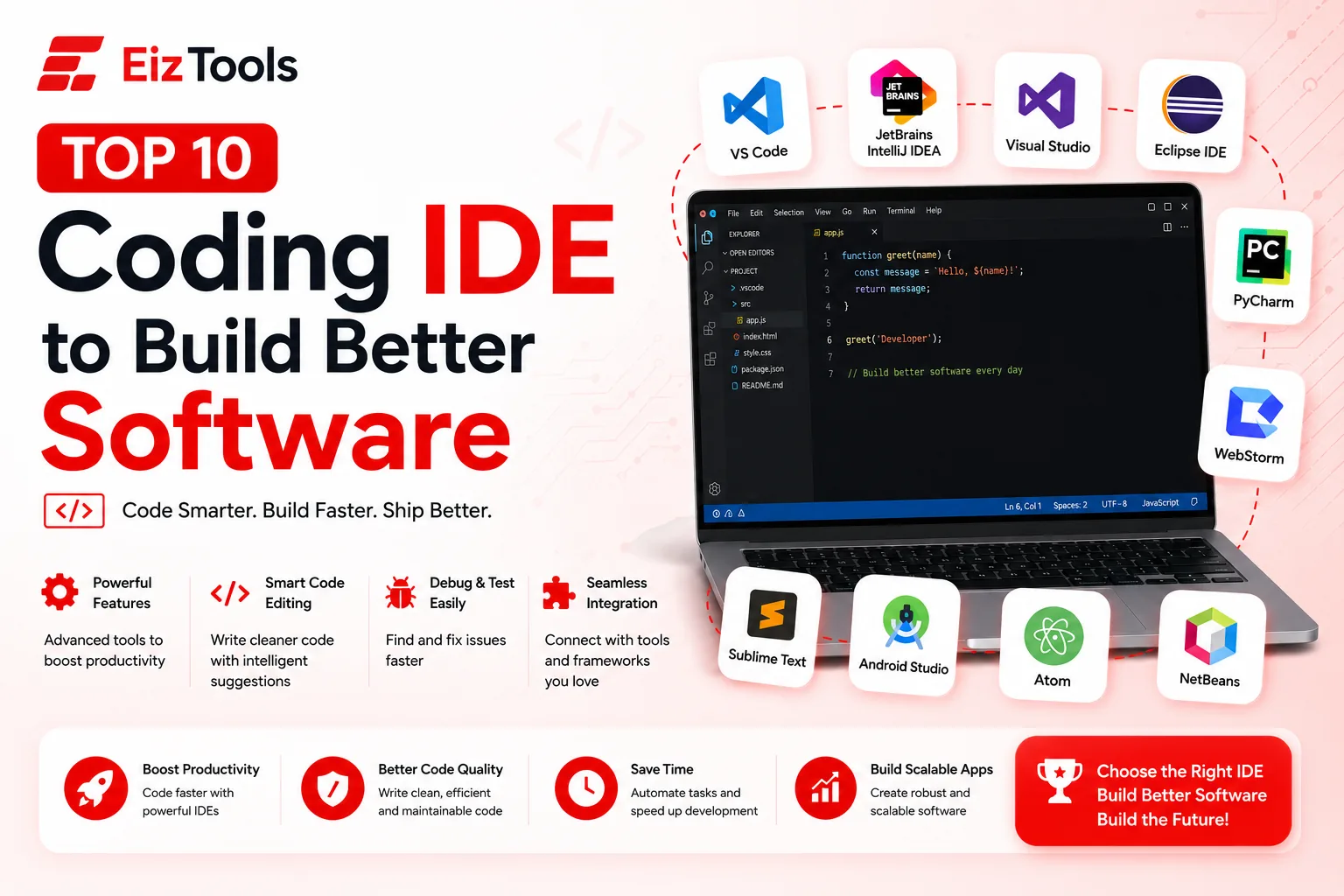
Top 10 Coding IDE to Build Better Software
Find the perfect coding environment that helps you write quality software faster, stay organized, and enjoy a smoother development experience daily.
Which coding IDE helps developers write cleaner code? Which one improves productivity without slowing down your workflow? Should beginners and professionals use the same development environment?
If you've ever asked these questions, you're in the right place. Choosing the right Integrated Development Environment (IDE) can dramatically improve your coding experience, whether you're building websites, mobile applications, enterprise software, or AI powered projects.
In this guide, we'll explore the Top 10 Coding IDE to Build Better Software, compare their strengths, highlight their best use cases, and help you select the right IDE for your development needs. Whether you're a student, freelancer, startup founder, or experienced software engineer, this article provides practical insights backed by industry usage.
You can also discover more free developer utilities, productivity tools, and coding resources on EizTools, a platform built to simplify everyday digital work.
What Is a Coding IDE?
A Coding IDE, or Integrated Development Environment, is software that combines everything developers need in one application. Instead of using separate programs for writing code, debugging, testing, and version control, an IDE brings these features together into a unified workspace.
Most modern IDEs include:
- Intelligent code editor
- Syntax highlighting
- Auto completion
- Built in debugger
- Terminal integration
- Git support
- Project management tools
- Extension marketplace
- Error detection and code analysis
The best Coding IDE saves time, reduces development errors, and improves collaboration across software teams.
Why Choosing the Right Coding IDE Matters
Your development environment influences productivity every day. A well designed IDE helps you focus on solving problems instead of managing tools.
- Write code faster with intelligent suggestions.
- Detect bugs before deployment.
- Navigate large projects efficiently.
- Improve code quality using built in inspections.
- Manage multiple programming languages from one workspace.
- Integrate directly with Git repositories.
- Run and debug applications without switching software.
Whether you're creating desktop software, websites, APIs, or mobile applications, selecting the right Coding IDE makes development smoother and more efficient.
Quick Comparison of the Top 10 Coding IDE to Build Better Software
| IDE | Best For | Popular Languages | Operating Systems |
|---|---|---|---|
| Visual Studio Code | General development | JavaScript, Python, C++, Java | Windows, macOS, Linux |
| IntelliJ IDEA | Java development | Java, Kotlin, Scala | Windows, macOS, Linux |
| Visual Studio | .NET development | C#, C++, VB.NET | Windows |
| Eclipse IDE | Enterprise Java | Java, C++, PHP | Windows, macOS, Linux |
| PyCharm | Python projects | Python | Windows, macOS, Linux |
| WebStorm | Frontend development | JavaScript, TypeScript | Windows, macOS, Linux |
| NetBeans | Java beginners | Java, PHP | Windows, macOS, Linux |
| Atom | Lightweight editing | Multiple languages | Windows, macOS, Linux |
| Android Studio | Android apps | Kotlin, Java | Windows, macOS, Linux |
| Sublime Text | Fast coding | Multiple languages | Windows, macOS, Linux |
1. Visual Studio Code
Visual Studio Code, commonly called VS Code, is one of the world's most popular development environments. Although technically a powerful code editor, its rich extension ecosystem allows it to function like a complete Coding IDE for almost every programming language.
Key Features
- Huge extension marketplace
- Integrated Git support
- Built in terminal
- AI coding assistant compatibility
- Remote development support
- Fast performance
- Custom themes and settings
Best For
Web developers, Python developers, DevOps engineers, full stack developers, and beginners.
Advantages
- Free and open source
- Lightweight compared to traditional IDEs
- Excellent community support
- Frequent updates
Limitations
- Requires extensions for advanced functionality
- Can consume memory with many installed plugins
2. JetBrains IntelliJ IDEA
IntelliJ IDEA is considered one of the best Java development environments available today. It provides intelligent code analysis, advanced refactoring, and deep understanding of large enterprise projects.
Key Features
- Smart code completion
- Powerful refactoring tools
- Integrated database support
- Framework support for Spring and Jakarta EE
- Git integration
- Advanced debugging
Best For
Professional Java developers, enterprise software teams, backend engineers, and Kotlin developers.
Advantages
- Outstanding productivity features
- Excellent code inspections
- Reliable navigation across large projects
- Professional development workflow
Limitations
- Ultimate edition requires a paid license
- Higher hardware requirements than lightweight editors
3. Visual Studio
Visual Studio remains one of Microsoft's flagship development environments. It is especially popular among developers building Windows applications, enterprise software, cloud solutions, and games.
Key Features
- Advanced debugger
- Integrated performance profiler
- GitHub integration
- Excellent C# support
- Azure cloud integration
- Powerful testing tools
Best For
.NET developers, desktop applications, enterprise software, cloud services, and game development using Unity.
Advantages
- Comprehensive development tools
- Professional debugging capabilities
- Excellent productivity features
- Strong Microsoft ecosystem integration
Limitations
- Large installation size
- Requires relatively powerful hardware
4. Eclipse IDE
Eclipse IDE has been trusted by developers for many years, particularly in enterprise Java development. Thanks to its plugin architecture, it supports many programming languages beyond Java.
Key Features
- Open source platform
- Large plugin ecosystem
- Strong Java development tools
- Git integration
- Cross platform compatibility
- Workspace management
Best For
Enterprise Java projects, academic environments, and developers working on long term software systems.
Advantages
- Completely free
- Highly customizable
- Large developer community
- Supports multiple programming languages
Limitations
- User interface feels dated compared to newer IDEs
- Performance depends on installed plugins
Looking for more development resources? Visit the EizTools Blog for practical tutorials, online utilities, and technology guides designed for developers and creators.
5. PyCharm
PyCharm is a professional Coding IDE designed specifically for Python development. Created by JetBrains, it provides intelligent coding assistance, advanced debugging, and excellent support for popular Python frameworks. Whether you're building web applications, automation scripts, machine learning models, or data science projects, PyCharm offers a streamlined development experience.
Key Features
- Smart Python code completion
- Built in debugger and test runner
- Integrated virtual environment management
- Support for Django, Flask, and FastAPI
- Database tools and SQL support
- Git integration
- Powerful code inspections
Best For
Python developers, data scientists, AI engineers, automation specialists, and backend developers.
Advantages
- Outstanding Python support
- Easy project navigation
- Professional debugging tools
- Excellent framework integration
Limitations
- Consumes more system resources than lightweight editors
- Professional features require the paid edition
6. WebStorm
WebStorm is another premium JetBrains Coding IDE focused on modern web development. It offers first class support for JavaScript, TypeScript, React, Vue, Angular, and Node.js, making it a favorite among frontend and full stack developers.
Key Features
- Advanced JavaScript and TypeScript support
- Intelligent code completion
- Integrated debugging tools
- Version control support
- Framework specific development tools
- Built in terminal
- Automated code refactoring
Best For
Frontend developers, full stack engineers, JavaScript professionals, and teams building modern web applications.
Advantages
- Excellent productivity features
- Reliable code quality inspections
- Deep framework integration
- Professional development workflow
Limitations
- Requires a commercial license
- Uses more memory than lightweight editors
7. NetBeans
Apache NetBeans is a free and open source Coding IDE that continues to be a reliable choice for Java developers. It also supports PHP, HTML, CSS, and JavaScript, making it suitable for both desktop and web development projects.
Key Features
- Built in Java support
- Project templates
- Visual GUI builder
- Code analysis tools
- Git integration
- Cross platform compatibility
Best For
Students, Java beginners, educators, and developers looking for a free development environment.
Advantages
- Completely free
- Simple installation process
- Stable performance
- Good Java support without additional plugins
Limitations
- Smaller extension ecosystem than VS Code
- Interface feels less modern than newer IDEs
8. Atom
Atom was created as a highly customizable code editor that could function like a lightweight Coding IDE through packages and community extensions. Although active development has ended, many developers still appreciate its clean interface and customization capabilities for existing projects.
Key Features
- Package based customization
- Built in Git integration
- Multiple panes
- Smart autocomplete
- Cross platform support
- Custom themes
Best For
Developers maintaining older projects, learners exploring customizable editors, and programmers who prefer a simple interface.
Advantages
- Easy to customize
- Clean and beginner friendly interface
- Supports many programming languages
- Large collection of community packages
Limitations
- No longer actively maintained
- Performance may slow with numerous packages installed
How to Choose the Best Coding IDE
Selecting the right Coding IDE depends on your programming language, project size, workflow, and hardware. Before making a decision, consider these factors.
- Choose an IDE that fully supports your primary programming language.
- Check whether it includes built in debugging and testing tools.
- Look for Git and version control integration.
- Evaluate extension availability for future scalability.
- Ensure the IDE performs well on your computer.
- Consider collaboration features if you work in a team.
- Compare free and paid editions before investing.
Comparison of IDE Features
| IDE | Free Version | Best Language | Beginner Friendly | Enterprise Ready |
|---|---|---|---|---|
| VS Code | Yes | Multiple | Yes | Yes |
| IntelliJ IDEA | Community Edition | Java | Yes | Yes |
| Visual Studio | Community Edition | C# | Yes | Yes |
| Eclipse IDE | Yes | Java | Moderate | Yes |
| PyCharm | Community Edition | Python | Yes | Yes |
| WebStorm | No | JavaScript | Yes | Yes |
| NetBeans | Yes | Java | Yes | Yes |
| Atom | Yes | Multiple | Yes | Limited |
9. Android Studio
Android Studio is Google's official Coding IDE for Android application development. Built on the IntelliJ platform, it includes everything developers need to design, build, test, and publish Android apps. It supports both Kotlin and Java while offering powerful emulators and performance analysis tools.
Key Features
- Official Android development environment
- Visual layout editor
- Android Emulator
- APK Analyzer
- Integrated Gradle build system
- Code completion and refactoring
- Performance profiler
Best For
Android application developers, mobile startups, enterprise mobile teams, and students learning Android development.
Advantages
- Direct support from Google
- Excellent Kotlin integration
- Professional debugging tools
- Rich testing capabilities
Limitations
- Requires a powerful computer for smooth performance
- Large installation size
10. Sublime Text
Sublime Text is known for its exceptional speed and clean interface. While technically a code editor, its plugin ecosystem enables it to function as a lightweight Coding IDE for many programming languages. Developers who prioritize performance often choose Sublime Text for everyday coding tasks.
Key Features
- Extremely fast startup
- Multiple cursor editing
- Command palette
- Split editing interface
- Package Control support
- Cross platform compatibility
- Highly customizable interface
Best For
Developers who prefer lightweight software, quick editing, scripting, and large codebases.
Advantages
- Very fast performance
- Minimal resource usage
- Easy customization
- Supports numerous programming languages
Limitations
- Requires plugins for IDE like functionality
- Some advanced features require additional configuration
Which Coding IDE Should You Choose?
The best Coding IDE depends on your goals and preferred programming language. Here are some practical recommendations.
| If You Are | Recommended IDE |
|---|---|
| Web Developer | Visual Studio Code or WebStorm |
| Java Developer | IntelliJ IDEA or Eclipse IDE |
| Python Developer | PyCharm |
| Android Developer | Android Studio |
| .NET Developer | Visual Studio |
| Student or Beginner | Visual Studio Code or NetBeans |
| Lightweight Development | Sublime Text |
Trying multiple IDEs is often the best way to find the one that matches your workflow. Most of the options listed above offer free editions or trial versions, making it easy to experiment before committing.
Free Tools That Sit Beside Your IDE
Whichever IDE you settle on, two jobs still interrupt the flow: writing a query against a schema you half remember, and decoding an error you have not seen before. The SQL Generator and the Error Fixer handle both in a browser tab, free and without an account, so you can stay in your editor for the work that actually needs it.
Frequently Asked Questions About Coding IDE
What is a Coding IDE?
A Coding IDE is an Integrated Development Environment that combines a code editor, debugger, compiler, terminal, and development tools into one application to simplify software development.
Which Coding IDE is best for beginners?
Visual Studio Code and NetBeans are excellent choices for beginners because they are easy to learn, well documented, and supported by large developer communities.
Which IDE is best for Python?
PyCharm is widely regarded as one of the best Python IDEs thanks to its intelligent code analysis, debugging tools, and framework support.
Is Visual Studio Code an IDE?
Visual Studio Code is primarily a code editor, but with extensions it provides many features found in a full Coding IDE, making it suitable for professional software development.
Which IDE is best for Java?
IntelliJ IDEA is considered the leading choice for Java development, while Eclipse IDE and NetBeans are also popular free alternatives.
Are free IDEs good enough for professional development?
Yes. Visual Studio Code, Eclipse IDE, NetBeans, and the Community Editions of IntelliJ IDEA and PyCharm are capable of supporting many professional software projects.
Final Thoughts on the Top 10 Coding IDE to Build Better Software
Selecting the right Top 10 Coding IDE to Build Better Software is an investment in your productivity. The right environment helps you write cleaner code, identify errors quickly, collaborate efficiently, and deliver high quality software faster.
If you need an all purpose solution, Visual Studio Code remains one of the most versatile choices. Java developers will appreciate IntelliJ IDEA, Python developers will benefit from PyCharm, Android developers should choose Android Studio, while Visual Studio continues to dominate the .NET ecosystem. Every IDE featured in this guide offers unique strengths, so your ideal choice depends on your projects, programming language, and workflow.
For more free developer tools, coding utilities, productivity resources, and practical technology guides, visit EizTools. You can also explore the latest tutorials on the EizTools Blog.
Thank you for reading. We appreciate your support of EizTools. Follow us on our social media channels, enable push notifications, and subscribe to our newsletter to receive the latest updates on developer tools, software resources, AI technologies, and productivity tips as soon as they're published.

Sabir Bepari
Founder of EizTools and a passionate AI enthusiast dedicated to building practical, user-friendly AI tools that simplify everyday tasks.
Join the Newsletter
Get the best new AI tools and tips delivered to your inbox. No spam.
By subscribing you agree to receive emails from EizTools. Unsubscribe anytime.
Follow EizTools
New AI tools, practical tips and product updates — straight to your feed.
Discussion 0
Join the conversation — share your thoughts, ask questions, help others.
No comments yet. Be the first to share your thoughts!

