

100 Best Developer Tools in 2026
Explore trusted developer tools that simplify coding, improve productivity, reduce repetitive work, and help build better software every single day.
Can the right developer tools save hours of work every week? Which tools are worth using in 2026? Should you choose lightweight coding utilities or complete development platforms?
If you have ever asked these questions, you are in the right place. This guide answers them with a carefully researched list of the 100 Best Developer Tools in 2026. Whether you are a beginner learning programming, a freelance developer, a startup founder, or part of an enterprise engineering team, choosing the right tools can improve productivity, collaboration, security, testing, deployment, and software quality.
Modern software development involves much more than writing code. Developers now rely on source control systems, integrated development environments, API testing platforms, cloud services, containers, security scanners, design collaboration software, automation platforms, monitoring tools, and AI powered coding assistants.
In this comprehensive guide, we explore the most reliable developer tools available today, explain their strengths, compare categories, and provide a reference table covering one hundred popular tools used by millions of developers worldwide.
EizTools is committed to helping developers discover practical software, productivity resources, and technical guides that make development easier. Explore more developer resources at EizTools.
What Are Developer Tools?
Developer tools are software applications and platforms that help programmers build, test, debug, deploy, secure, and maintain software projects efficiently. Instead of manually performing repetitive tasks, developers use specialized tools to automate workflows and improve code quality.
A modern development workflow often includes:
- Writing source code
- Managing Git repositories
- Testing applications
- Reviewing code
- Deploying software
- Monitoring applications
- Managing cloud infrastructure
- Tracking bugs
- Collaborating with teams
The best developer tools integrate seamlessly with one another, helping teams deliver software faster while maintaining security and reliability.
Why the Best Developer Tools Matter in 2026
Software development has evolved rapidly over the past few years. AI assisted coding, cloud native applications, containerization, DevOps automation, and continuous deployment have become standard practices across the industry.
Choosing the best developer tools in 2026 offers several advantages:
- Faster development cycles
- Improved code quality
- Better collaboration across teams
- Reduced deployment risks
- Simplified debugging
- Automated testing
- Enhanced security
- Higher productivity
- Reliable project management
- Better scalability
Whether you build websites, mobile apps, enterprise software, APIs, games, or AI applications, selecting the right tools directly impacts project success.
How We Selected the 100 Best Developer Tools in 2026
This article evaluates developer tools based on multiple factors rather than popularity alone.
- Industry adoption
- Developer community support
- Performance and reliability
- Ease of learning
- Integration capabilities
- Security features
- Documentation quality
- Cross platform compatibility
- Active product development
- Real world usage by professional teams
The result is a balanced collection suitable for beginners, experienced developers, startups, and enterprise organizations.
Categories Covered in This Best Developer Tools Guide
| Category | Purpose |
|---|---|
| Code Editors | Writing and editing source code |
| IDEs | Complete software development environments |
| Version Control | Source code collaboration |
| API Development | Testing and managing APIs |
| Containers | Application packaging and deployment |
| Cloud Platforms | Infrastructure and hosting |
| CI CD | Automated software delivery |
| Monitoring | Application performance tracking |
| Security | Code and dependency protection |
| Developer Productivity | Automation and workflow improvement |
Essential Features Every Developer Tool Should Have
Before investing time in learning a new platform, consider these important characteristics.
- Reliable performance
- Excellent documentation
- Regular feature updates
- Cross platform compatibility
- Strong community support
- Integration with Git workflows
- Automation capabilities
- Security focused architecture
- Scalable pricing
- Developer friendly user experience
The best developer tools are not necessarily the most expensive. Many open source solutions outperform commercial software depending on project requirements.
Comparison of Major Developer Tool Categories
| Category | Primary Use | Ideal For |
|---|---|---|
| Code Editors | Writing code | All developers |
| IDEs | Complete development | Professional teams |
| Git Platforms | Version control | Collaboration |
| Cloud Services | Hosting applications | Scalable projects |
| Containers | Portable deployments | DevOps teams |
| Testing Tools | Quality assurance | Software testing |
| Monitoring | Performance analysis | Production systems |
| Security Tools | Protect applications | Enterprise software |
Top Developer Tools Every Programmer Should Know
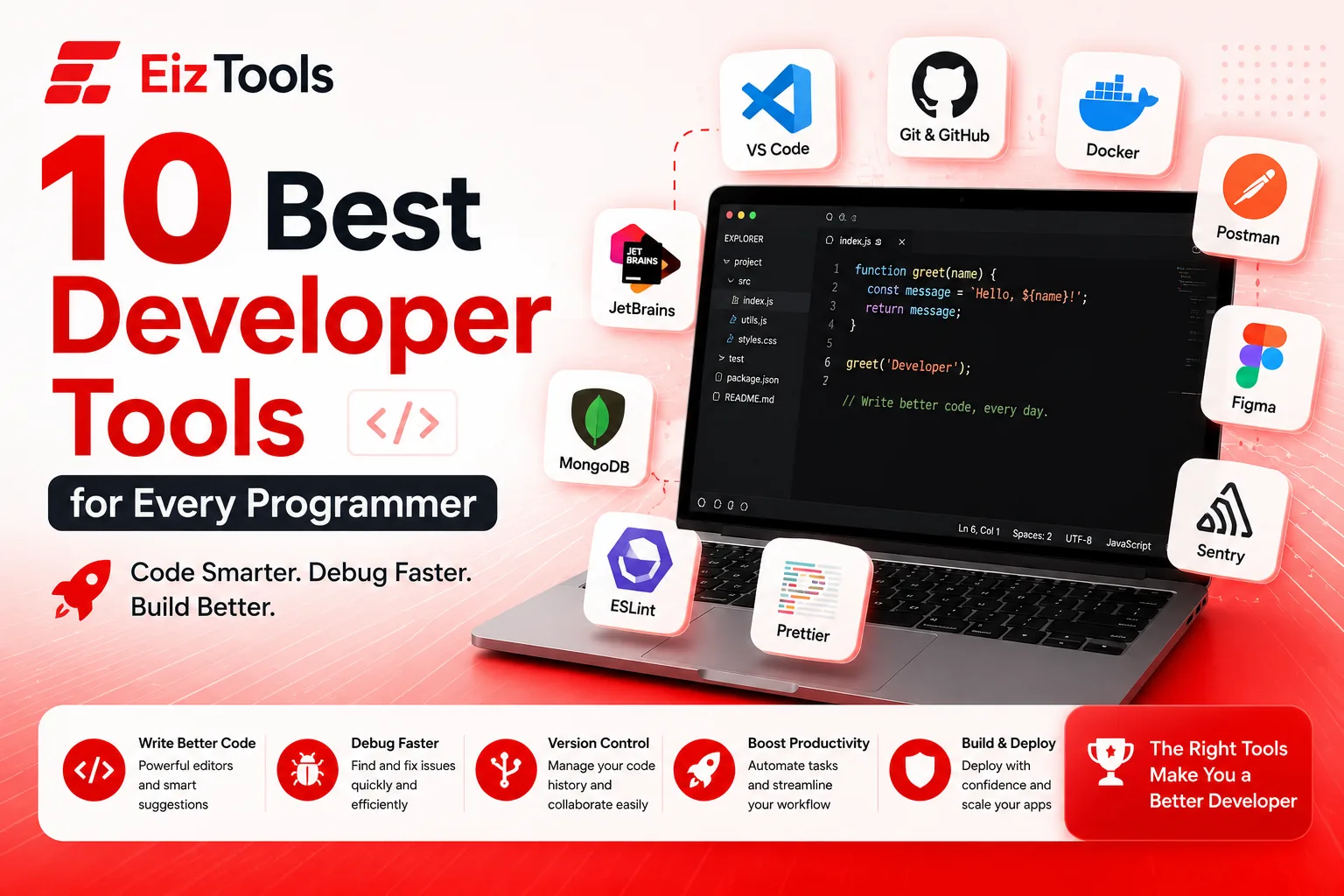
The modern development ecosystem includes thousands of applications, but a small group of platforms consistently appears across professional engineering teams. These tools have earned their reputation through reliability, innovation, and broad adoption.
| Tool | Primary Purpose | Best For |
|---|---|---|
| Visual Studio Code | Code editor | General development |
| Git | Version control | Source management |
| GitHub | Repository hosting | Team collaboration |
| Docker | Containerization | Application deployment |
| Postman | API testing | Backend developers |
| JetBrains IntelliJ IDEA | IDE | Java development |
| Figma | UI collaboration | Frontend teams |
| Jenkins | CI CD | Automation |
| Kubernetes | Container orchestration | Cloud infrastructure |
| Terraform | Infrastructure automation | DevOps engineers |
Benefits of Using the Best Developer Tools
- Reduce repetitive work through automation.
- Improve software quality with automated testing.
- Collaborate efficiently with distributed teams.
- Deploy applications more confidently.
- Identify bugs earlier in development.
- Maintain consistent coding standards.
- Improve project documentation.
- Strengthen application security.
- Scale projects without changing workflows.
- Increase overall developer productivity.
Many of these platforms also integrate with AI assistants, making coding, documentation, debugging, and code reviews significantly faster than traditional workflows.
Choosing the Right Developer Tools for Your Projects
No single software solution fits every development team. A frontend developer may prioritize code editors and browser debugging tools, while backend engineers often depend on API platforms, containers, databases, and cloud infrastructure.
When selecting your toolkit, evaluate:
- Programming languages you use
- Project size
- Team collaboration needs
- Deployment environment
- Budget
- Security requirements
- Learning curve
- Available integrations
As your projects grow, your development stack will naturally evolve. Starting with reliable, industry proven software makes that transition much smoother.
For more software recommendations, practical utilities, and productivity resources, visit the EizTools Blog.
100 Best Developer Tools in 2026
The following table includes one hundred of the most widely used developer tools across software engineering, web development, cloud computing, DevOps, testing, databases, security, collaboration, and AI assisted development.
| # | Developer Tool | Category | Primary Use |
|---|---|---|---|
| 1 | Visual Studio Code | Code Editor | Code editing |
| 2 | Visual Studio | IDE | Application development |
| 3 | IntelliJ IDEA | IDE | Java development |
| 4 | PyCharm | IDE | Python development |
| 5 | WebStorm | IDE | JavaScript development |
| 6 | PhpStorm | IDE | PHP development |
| 7 | Android Studio | IDE | Android apps |
| 8 | Xcode | IDE | Apple development |
| 9 | Eclipse | IDE | Enterprise Java |
| 10 | NetBeans | IDE | Java projects |
| 11 | Git | Version Control | Source management |
| 12 | GitHub | Repository | Code hosting |
| 13 | GitLab | Repository | DevOps platform |
| 14 | Bitbucket | Repository | Git collaboration |
| 15 | SourceTree | Git Client | Git interface |
| 16 | Docker | Containers | Containerization |
| 17 | Kubernetes | Containers | Container orchestration |
| 18 | Podman | Containers | Container management |
| 19 | Helm | Kubernetes | Package management |
| 20 | Minikube | Kubernetes | Local clusters |
| 21 | Postman | API | API testing |
| 22 | Insomnia | API | REST testing |
| 23 | Swagger | API | API documentation |
| 24 | Hoppscotch | API | API requests |
| 25 | Bruno | API | Offline API testing |
| 26 | Jenkins | CI CD | Automation |
| 27 | GitHub Actions | CI CD | Workflow automation |
| 28 | CircleCI | CI CD | Continuous integration |
| 29 | Travis CI | CI CD | Build automation |
| 30 | Azure DevOps | CI CD | Development pipelines |
| 31 | AWS | Cloud | Cloud infrastructure |
| 32 | Google Cloud | Cloud | Cloud hosting |
| 33 | Microsoft Azure | Cloud | Enterprise cloud |
| 34 | DigitalOcean | Cloud | Virtual servers |
| 35 | Vercel | Hosting | Frontend deployment |
| 36 | Netlify | Hosting | Static websites |
| 37 | Cloudflare | Cloud | Performance and security |
| 38 | Render | Hosting | Application hosting |
| 39 | Railway | Hosting | Backend deployment |
| 40 | Fly.io | Hosting | Global applications |
| 41 | Terraform | Infrastructure | Infrastructure as code |
| 42 | Ansible | Automation | Configuration management |
| 43 | Pulumi | Infrastructure | Cloud automation |
| 44 | Chef | Automation | Infrastructure automation |
| 45 | Puppet | Automation | Server management |
| 46 | Redis | Database | In memory database |
| 47 | PostgreSQL | Database | Relational database |
| 48 | MySQL | Database | SQL database |
| 49 | MongoDB | Database | NoSQL database |
| 50 | SQLite | Database | Embedded database |
| 51 | DBeaver | Database | Database management |
| 52 | TablePlus | Database | Database client |
| 53 | pgAdmin | Database | PostgreSQL management |
| 54 | MongoDB Compass | Database | MongoDB GUI |
| 55 | RedisInsight | Database | Redis monitoring |
| 56 | Figma | Design | UI collaboration |
| 57 | Penpot | Design | Open source UI |
| 58 | Zeplin | Design | Developer handoff |
| 59 | Storybook | Frontend | Component development |
| 60 | Chrome DevTools | Browser | Debugging |
| 61 | Firefox Developer Tools | Browser | Web debugging |
| 62 | Lighthouse | Performance | Website audits |
| 63 | Webpack | Build Tool | Bundling |
| 64 | Vite | Build Tool | Frontend builds |
| 65 | Parcel | Build Tool | Zero config builds |
| 66 | ESLint | Quality | Linting |
| 67 | Prettier | Formatting | Code formatting |
| 68 | SonarQube | Quality | Code quality |
| 69 | CodeClimate | Quality | Maintainability |
| 70 | Semgrep | Security | Static analysis |
| 71 | Snyk | Security | Dependency scanning |
| 72 | OWASP ZAP | Security | Security testing |
| 73 | Burp Suite | Security | Penetration testing |
| 74 | HashiCorp Vault | Security | Secrets management |
| 75 | Trivy | Security | Container scanning |
| 76 | Prometheus | Monitoring | Metrics collection |
| 77 | Grafana | Monitoring | Dashboards |
| 78 | Datadog | Monitoring | Infrastructure monitoring |
| 79 | New Relic | Monitoring | Performance monitoring |
| 80 | Sentry | Monitoring | Error tracking |
| 81 | Slack | Communication | Team messaging |
| 82 | Microsoft Teams | Communication | Team collaboration |
| 83 | Discord | Communication | Developer communities |
| 84 | Notion | Documentation | Knowledge management |
| 85 | Confluence | Documentation | Team documentation |
| 86 | Jira | Project Management | Issue tracking |
| 87 | Trello | Project Management | Task management |
| 88 | Linear | Project Management | Engineering workflows |
| 89 | ClickUp | Project Management | Work management |
| 90 | Asana | Project Management | Project planning |
| 91 | GitHub Copilot | AI Coding | Code completion |
| 92 | Claude | AI Assistant | Programming assistance |
| 93 | ChatGPT | AI Assistant | Code generation |
| 94 | Gemini | AI Assistant | Development support |
| 95 | Cursor | AI IDE | AI coding |
| 96 | Windsurf | AI IDE | AI development |
| 97 | Continue | AI Extension | AI coding assistant |
| 98 | Tabnine | AI Coding | Code completion |
| 99 | Codeium | AI Coding | AI programming |
| 100 | Aider | AI Coding | Terminal AI coding |
Best Developer Tools by Category
Code Editors and IDEs
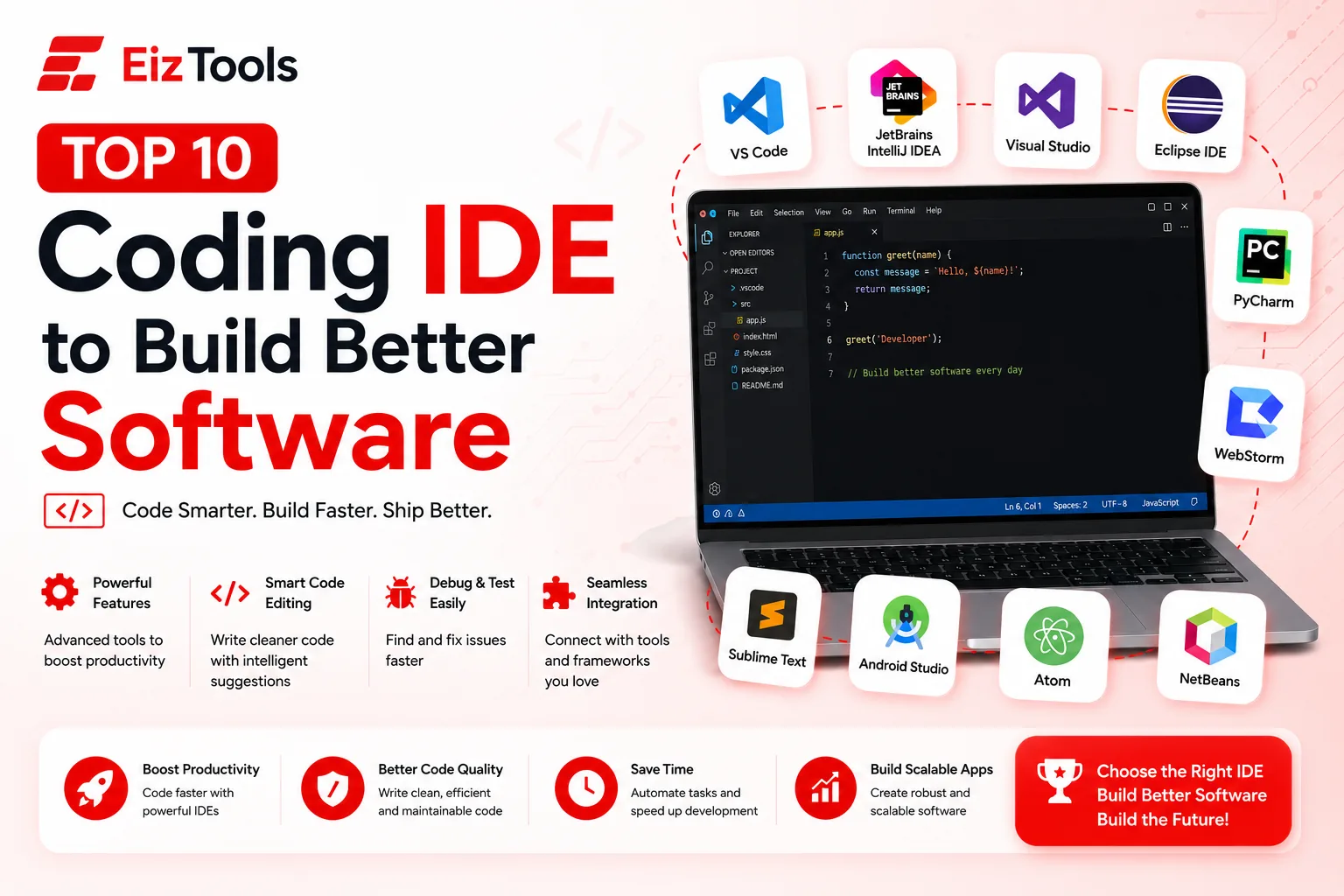
Visual Studio Code continues to be one of the most popular development environments because of its speed, extensive extension marketplace, Git integration, debugging support, and compatibility with nearly every programming language. Developers who require language specific capabilities often choose IntelliJ IDEA, PyCharm, Android Studio, or Xcode.
Version Control Tools
Git remains the industry standard for source control, while GitHub, GitLab, and Bitbucket simplify collaboration through pull requests, issue tracking, code reviews, and continuous integration pipelines.
Container and DevOps Tools
Docker and Kubernetes have transformed software deployment by making applications portable across environments. Infrastructure automation platforms like Terraform and Ansible reduce manual server configuration and improve deployment consistency.
Cloud Development Platforms
AWS, Microsoft Azure, Google Cloud Platform, DigitalOcean, Render, Railway, and Vercel provide scalable hosting environments for everything from personal projects to enterprise applications. Developers can deploy globally without managing physical infrastructure.
Testing and API Development
API first development continues to grow. Tools such as Postman, Swagger, Insomnia, Bruno, and Hoppscotch simplify API testing, documentation, and collaboration across frontend and backend teams.
AI Powered Developer Tools
Artificial intelligence has become an important part of software engineering. GitHub Copilot, Cursor, Windsurf, ChatGPT, Claude, Gemini, Tabnine, Codeium, Continue, and Aider assist developers with code generation, debugging, documentation, and learning unfamiliar technologies.
How to Choose the Best Developer Tools in 2026
Selecting the right development stack depends on your programming language, project size, deployment strategy, and team workflow. Instead of installing every available platform, choose tools that integrate well with each other and solve real development challenges.
| Need | Recommended Tool Types |
|---|---|
| Web Development | VS Code, GitHub, Docker, Vercel |
| Backend APIs | Postman, Docker, PostgreSQL, Redis |
| Mobile Apps | Android Studio, Xcode, Firebase |
| Cloud Projects | AWS, Terraform, Kubernetes |
| DevOps | GitHub Actions, Jenkins, Grafana |
| AI Development | Cursor, GitHub Copilot, Claude |
The best developer tools in 2026 are those that improve productivity without adding unnecessary complexity. Start with a lightweight toolkit and expand it as your projects become more sophisticated.
Two Additions to the List
Nothing on a list this long covers the small interruptions. Writing a query against a schema you only half remember is one; reading an unfamiliar stack trace is the other. The SQL Generator and the Error Fixer each handle one of them in a browser tab, free and with no account, which is often all the tooling a five-minute problem deserves.
Frequently Asked Questions About the Best Developer Tools in 2026
What are developer tools?
Developer tools are software applications that help programmers write, test, debug, deploy, monitor, and maintain software. They include code editors, IDEs, version control platforms, cloud services, API testing tools, database clients, CI CD platforms, and AI coding assistants.
Which is the best developer tool in 2026?
There is no single best tool for every developer. Visual Studio Code remains one of the most widely used code editors, Git is the standard for version control, Docker leads containerization, and GitHub continues to be a popular platform for collaboration. The best choice depends on your programming language, workflow, and project requirements.
Are free developer tools good enough for professional projects?
Yes. Many professional engineering teams rely on free and open source tools such as Git, Visual Studio Code, Docker, Kubernetes, PostgreSQL, Redis, and GitHub. These platforms power startups as well as enterprise applications around the world.
Which developer tools are best for beginners?
Beginners should start with Visual Studio Code, Git, GitHub, Postman, Docker, and a database such as PostgreSQL or MySQL. These tools provide an excellent foundation and are widely used in professional software development.
How do AI developer tools improve productivity?
AI powered developer tools can generate code snippets, explain unfamiliar code, write documentation, identify bugs, suggest improvements, and automate repetitive programming tasks. Used responsibly, they help developers work faster while maintaining code quality.
Do I need all 100 developer tools?
No. Most developers only use a small collection of tools daily. The right combination depends on your technology stack, project size, and development workflow. This guide is intended as a reference so you can discover tools that fit your specific needs.
Common Mistakes When Choosing Developer Tools
Many developers install every trending application they come across, hoping it will improve productivity. In reality, an overloaded workflow often leads to unnecessary complexity. Choosing tools based on your actual requirements is far more effective than following every new trend.
- Installing too many tools without a clear purpose.
- Ignoring documentation and community support.
- Choosing tools that do not integrate with existing workflows.
- Overlooking security and compliance features.
- Using outdated software versions.
- Skipping automation opportunities.
- Not evaluating scalability for future projects.
- Failing to back up repositories and configurations.
Future Trends for Developer Tools
The software development landscape continues to evolve rapidly. Over the next few years, developers can expect deeper AI integration, improved cloud native workflows, and greater automation across the software lifecycle.
Some important trends include:
- AI first development environments.
- Autonomous testing and debugging.
- Smarter code reviews powered by machine learning.
- Improved cloud native deployment platforms.
- Enhanced DevSecOps automation.
- Low code and no code integration with traditional development.
- Real time collaborative coding environments.
- Better security scanning throughout development pipelines.
Keeping up with these advancements helps developers remain competitive while building more reliable and scalable software.
The 100 Best Developer Tools in 2026 featured in this guide represent some of the most trusted solutions used by developers across startups, enterprises, and open source communities. From code editors and IDEs to cloud platforms, DevOps automation, API testing, databases, monitoring, security, and AI powered assistants, every tool serves a specific purpose in modern software development.
Instead of trying to master every platform, focus on building a toolkit that aligns with your projects and workflow. Start with reliable essentials, learn them well, and gradually expand your stack as your experience grows. Investing time in the right developer tools will improve productivity, collaboration, software quality, and long term career growth.
If you found this guide helpful, continue exploring more developer resources, productivity tools, software comparisons, and technical tutorials on EizTools. You can also visit our Blog for the latest technology articles, buying guides, and software recommendations.
Thank you for reading. Join the EizTools community by following us on our social media channels, enabling push notifications, and subscribing to our newsletter. You'll receive the latest developer tool discoveries, software updates, expert tutorials, productivity tips, and technology news as soon as they are published.

Sabir Bepari
Founder of EizTools and a passionate AI enthusiast dedicated to building practical, user-friendly AI tools that simplify everyday tasks.
Join the Newsletter
Get the best new AI tools and tips delivered to your inbox. No spam.
By subscribing you agree to receive emails from EizTools. Unsubscribe anytime.
Follow EizTools
New AI tools, practical tips and product updates — straight to your feed.
Discussion 0
Join the conversation — share your thoughts, ask questions, help others.
No comments yet. Be the first to share your thoughts!

