

Best AI Tools for Research and Learning
Learn smarter with AI tools that simplify research, organize information, improve understanding, and help you study more effectively every day.
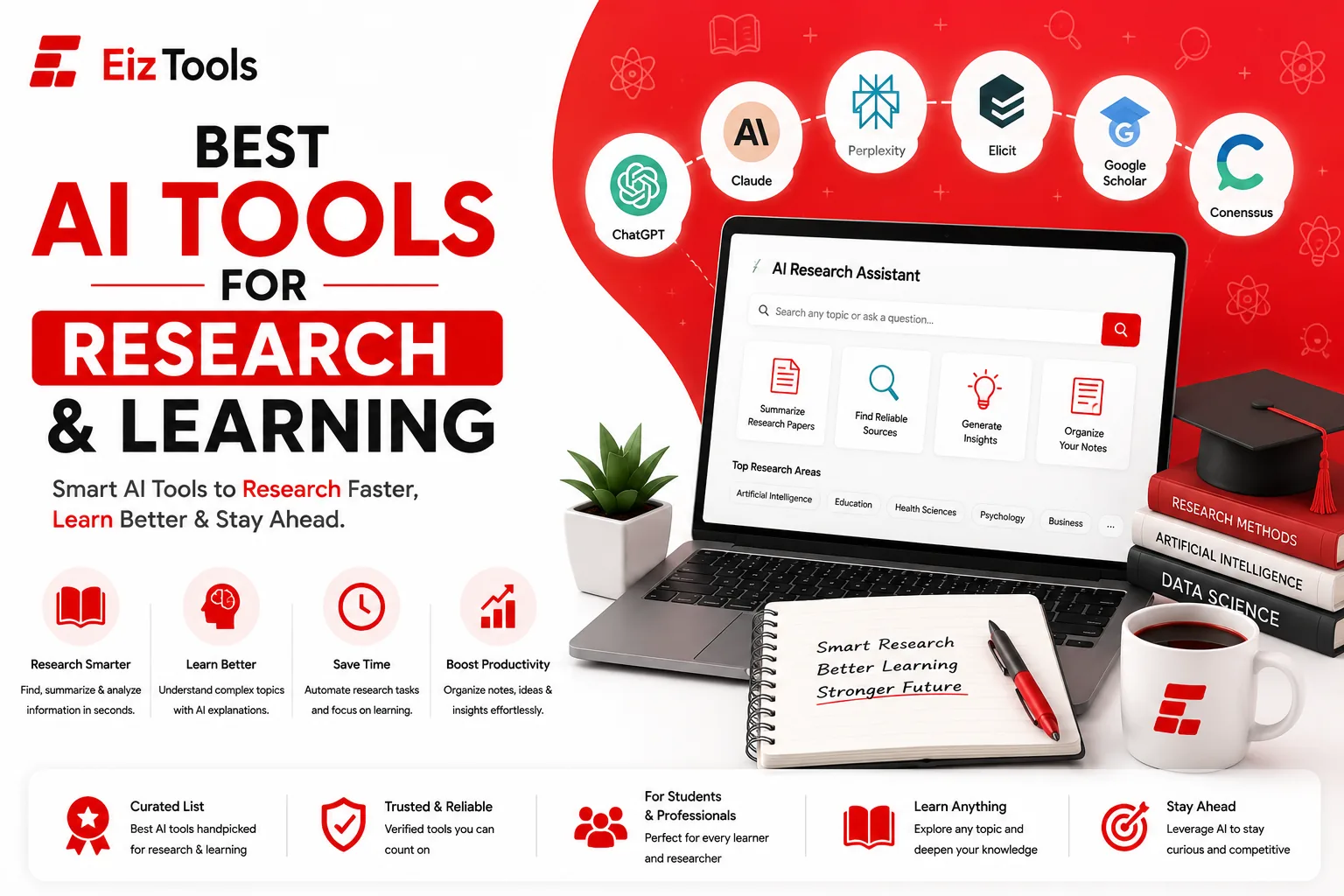
Are you spending hours searching for reliable information online? Do you struggle to organize notes, summarize research papers, or understand complex topics quickly?
If your answer is yes, you're not alone. Modern AI tools have changed the way students, researchers, educators, content creators, and professionals learn and conduct research. Instead of manually reading dozens of websites, PDFs, journals, and reports, AI can help summarize information, explain difficult concepts, compare sources, organize notes, and even generate study materials in minutes.
This guide explores the Best AI Tools for Research and Learning, explaining what each tool does, where it excels, and how to choose the right one for your needs. Whether you're writing academic papers, preparing presentations, learning new skills, or conducting business research, this article will help you make an informed decision.
For more AI resources, tutorials, and productivity tools, visit EizTools, where we regularly publish practical guides for AI users.
What Are the Best AI Tools for Research and Learning?
The Best AI Tools for Research and Learning are intelligent applications that help users discover information, analyze documents, summarize research, answer questions, generate citations, organize knowledge, and improve learning efficiency. These tools use large language models, machine learning, and natural language processing to simplify research tasks that traditionally required significant manual effort.
Rather than replacing critical thinking, AI tools act as research assistants by helping users find relevant information faster and spend more time understanding and applying knowledge.
Quick Comparison of the Best AI Tools for Research and Learning
| AI Tool | Best For | Key Strength | Free Plan |
|---|---|---|---|
| ChatGPT | General research | Explanations and brainstorming | Yes |
| Google Gemini | Web assisted research | Google ecosystem integration | Yes |
| Claude | Long documents | Large context window | Yes |
| Perplexity AI | Fact finding | Source citations | Yes |
| Elicit | Academic research | Research paper analysis | Yes |
| Consensus | Scientific evidence | Research based answers | Yes |
| NotebookLM | Personal study | Document based learning | Yes |
| Scite | Citation analysis | Smart citation tracking | Limited |
| Connected Papers | Literature discovery | Research visualization | Limited |
| Semantic Scholar | Academic search | AI powered paper discovery | Yes |
Why the Best AI Tools for Research and Learning Matter
Research has become increasingly complex because information is spread across journals, books, websites, videos, reports, and databases. AI tools help simplify this process by reducing repetitive work while improving productivity.
- Find reliable information faster.
- Summarize lengthy documents.
- Explain technical concepts in simple language.
- Generate study notes.
- Create outlines for reports.
- Compare multiple sources.
- Identify research gaps.
- Improve learning efficiency.
Best AI Tools for Research and Learning You Should Try
1. ChatGPT
ChatGPT is one of the most versatile AI assistants available today. It helps users understand concepts, summarize articles, brainstorm ideas, create study plans, explain difficult topics, and improve writing.
Students often use ChatGPT to simplify complex subjects, while professionals rely on it for market research, report drafting, and learning new technologies.
Best Features- Natural conversations
- Detailed explanations
- Content summarization
- Brainstorming assistance
- Coding support
- Learning assistance
Best For: Everyday research and learning.
2. Google Gemini
Google Gemini combines AI with Google's ecosystem, making it especially useful for users who work with Google Docs, Gmail, Drive, and Search.
It can answer research questions, summarize documents, generate study notes, and assist with academic or professional writing while integrating naturally into existing workflows.
Key Advantages- Google Workspace integration
- Strong multimodal capabilities
- Fast information retrieval
- Document analysis
- Image understanding
Best For: Google Workspace users and researchers.
3. Claude
Claude is widely appreciated for its ability to process very large documents. Researchers frequently upload reports, books, contracts, and research papers for detailed analysis.
Its conversational style makes it easy to ask follow up questions without losing context.
Highlights- Large context window
- Excellent document summaries
- Logical reasoning
- Professional writing support
- Academic assistance
Best For: Reading lengthy documents and detailed research.
4. Perplexity AI
Perplexity AI focuses on delivering research backed answers with references. Instead of simply generating responses, it provides links to supporting sources so users can verify information independently.
This makes it particularly useful for journalists, researchers, students, and professionals who require trustworthy references.
Strengths- Source citations
- Fast web research
- Current information
- Follow up questions
- Research transparency
Best For: Fact checking and source based research.
5. Elicit
Elicit is designed specifically for academic research. Instead of searching the web broadly, it focuses on scientific literature and helps researchers identify relevant papers quickly.
It can summarize findings, compare research methods, extract important information, and assist with systematic literature reviews.
Features- Paper summaries
- Evidence extraction
- Research comparison
- Academic workflows
- Literature reviews
Best For: Scientific and academic research.
6. Consensus
Consensus answers questions using published scientific research instead of general web content. It searches peer reviewed studies and summarizes evidence from trusted publications.
This approach helps users make evidence based decisions rather than relying solely on opinions.
Benefits- Scientific search engine
- Research summaries
- Evidence based answers
- Academic references
- Reliable information
Best For: Medical, health, science, and evidence based learning.
7. NotebookLM
NotebookLM allows users to upload their own documents and create an AI powered knowledge base. Instead of searching the internet, it answers questions using the materials you provide.
Students often use NotebookLM to organize lecture notes, textbooks, PDFs, and class materials into a searchable study assistant.
Main Features- Document based AI assistant
- Question answering
- Research organization
- Study note generation
- Knowledge management
Best For: Personal learning and study management.
8. Scite
Scite goes beyond traditional citations by showing whether scientific papers support, contradict, or simply mention previous research. This provides valuable context when evaluating research quality.
Researchers can quickly understand how influential a study is within the academic community.
Top Features- Smart citations
- Citation context
- Research evaluation
- Reference tracking
- Evidence analysis
Best For: Academic citation analysis.
How the Best AI Tools for Research and Learning Improve Productivity
The Best AI Tools for Research and Learning significantly reduce the time required to gather information, summarize documents, compare multiple sources, and organize knowledge. Instead of spending several hours manually reading articles, researchers can quickly identify the most relevant materials and focus on understanding insights rather than searching for them.
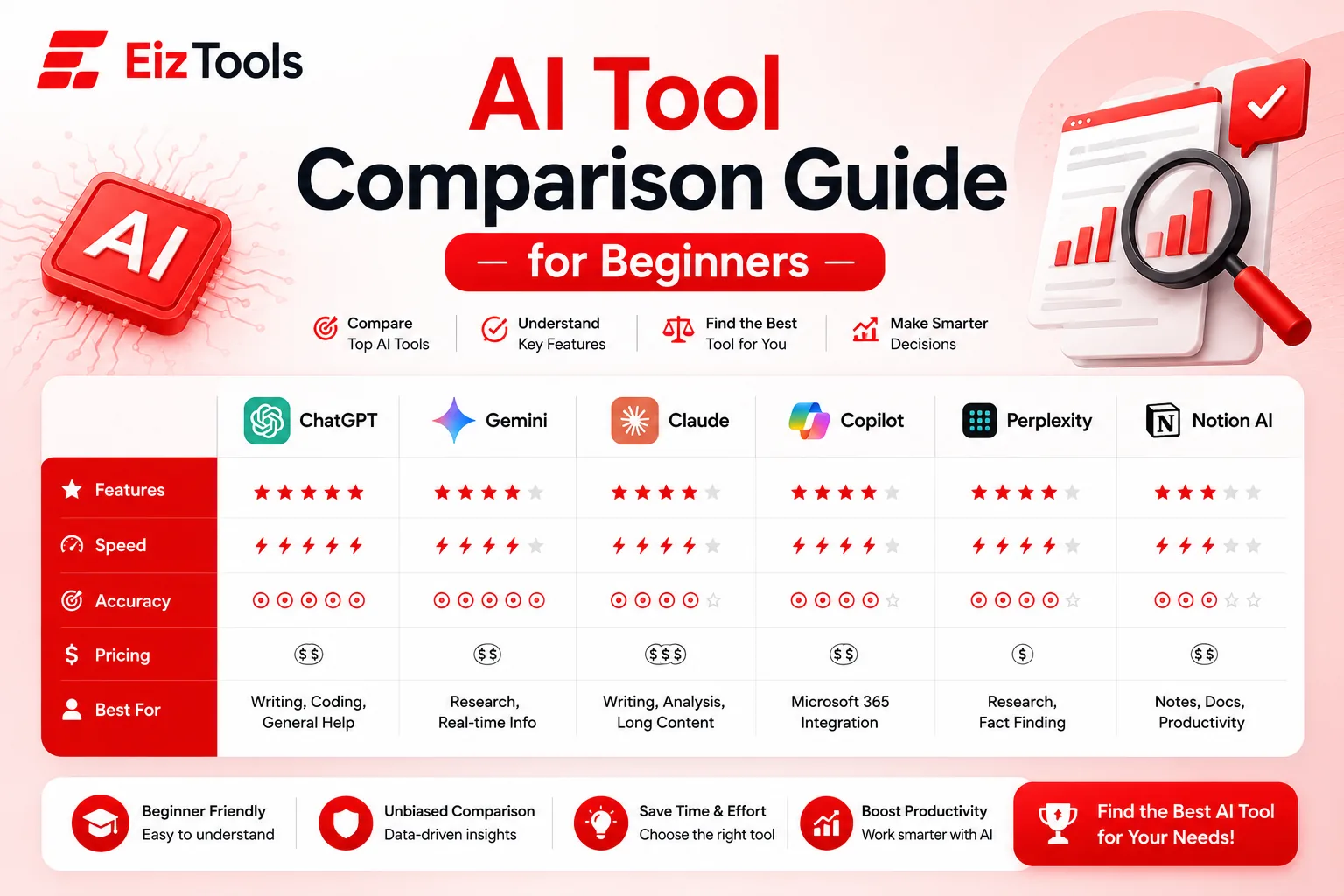
Many professionals combine several AI tools together. For example, they may use Perplexity AI to discover reliable sources, Claude to analyze long reports, NotebookLM to organize documents, and ChatGPT to explain difficult concepts or generate structured notes.
You can explore more AI learning resources, software reviews, and productivity guides on EizTools Blog.
9. Connected Papers
Connected Papers helps researchers discover relationships between academic papers through visual graphs. Instead of browsing endless search results, users can quickly identify influential studies, foundational research, and newer publications related to a topic.
It is particularly useful during the early stages of literature reviews because it reveals how research has evolved over time.
Key Features- Interactive research graphs
- Related paper discovery
- Visual literature exploration
- Citation relationship mapping
- Research trend analysis
Best For: Exploring academic literature and discovering related publications.
10. Semantic Scholar
Semantic Scholar is an AI powered academic search engine developed to help researchers find high quality scientific publications quickly. Its intelligent search capabilities surface influential papers while filtering irrelevant results.
Researchers can explore citation networks, author profiles, and related publications without manually searching multiple databases.
Key Features- AI powered academic search
- Citation analysis
- Research recommendations
- Author insights
- Scientific paper discovery
Best For: Students, professors, and academic researchers.
Comparison of the Best AI Tools for Research and Learning
| Tool | Research Quality | Learning Support | Source Citations | Academic Focus |
|---|---|---|---|---|
| ChatGPT | Excellent | Excellent | Limited | Good |
| Gemini | Excellent | Excellent | Moderate | Good |
| Claude | Excellent | Excellent | Limited | Very Good |
| Perplexity AI | Excellent | Very Good | Excellent | Very Good |
| Elicit | Excellent | Good | Excellent | Excellent |
| Consensus | Excellent | Good | Excellent | Excellent |
| NotebookLM | Very Good | Excellent | Based on uploaded files | Very Good |
| Scite | Excellent | Good | Excellent | Excellent |
| Connected Papers | Excellent | Moderate | Excellent | Excellent |
| Semantic Scholar | Excellent | Good | Excellent | Excellent |
Who Should Use the Best AI Tools for Research and Learning?
The Best AI Tools for Research and Learning are useful across education, business, technology, healthcare, marketing, and many other industries. Each type of user can benefit from AI in different ways.
- Students preparing assignments and exam notes.
- Researchers conducting literature reviews.
- Teachers creating educational materials.
- Content creators gathering accurate information.
- Business analysts researching markets.
- Developers learning new programming technologies.
- Medical professionals reviewing scientific studies.
- Journalists verifying information from multiple sources.
- Entrepreneurs researching competitors and industries.
- Lifelong learners exploring new skills.
How to Choose the Best AI Tools for Research and Learning
Different AI platforms are designed for different types of research. Before selecting one, consider your goals and workflow.
- Identify whether you need academic or general research.
- Check if the tool provides trustworthy source citations.
- Evaluate document upload capabilities.
- Look for collaboration features if working in teams.
- Compare free and paid plans.
- Review privacy policies before uploading sensitive files.
- Choose tools that integrate with your existing workflow.
- Test multiple platforms before committing to one.
Benefits of Using the Best AI Tools for Research and Learning
- Save hours of manual research.
- Understand difficult concepts more quickly.
- Summarize lengthy documents in minutes.
- Organize research efficiently.
- Improve learning outcomes.
- Discover reliable academic sources.
- Generate structured notes.
- Increase productivity.
- Reduce repetitive tasks.
- Support evidence based decision making.
Best Practices When Using AI for Research
AI should support your research process rather than replace critical thinking. Following a few best practices helps produce more reliable and accurate results.
- Verify important facts using original sources.
- Read cited research papers whenever possible.
- Compare information across multiple AI tools.
- Use clear and specific prompts.
- Keep your own research notes.
- Check publication dates for current information.
- Review AI generated summaries carefully.
- Avoid copying AI generated content without editing.
Common Mistakes to Avoid
Even the Best AI Tools for Research and Learning have limitations. Avoid these common mistakes to improve research quality.
- Accepting AI responses without verification.
- Ignoring original research papers.
- Depending on only one AI platform.
- Uploading confidential information without checking privacy policies.
- Using outdated sources.
- Skipping citation verification.
- Using vague prompts.
- Confusing AI generated opinions with scientific evidence.
Real World Examples
University Student
A university student can use Perplexity AI to discover reliable references, Elicit to identify relevant research papers, NotebookLM to organize lecture notes, and ChatGPT to simplify complex theories before examinations.
Business Researcher
A market analyst may combine Gemini for industry information, Claude for analyzing lengthy reports, and ChatGPT for preparing executive summaries and presentations.
Content Creator
Writers often use Semantic Scholar and Consensus to verify scientific information before using ChatGPT to convert technical concepts into reader friendly articles.
Software Developer
Developers can learn new programming frameworks by using ChatGPT for explanations, Claude for documentation analysis, and Gemini for additional technical references.
Can You Use Multiple AI Research Tools Together?
Absolutely. Many experienced researchers combine several AI platforms because each one has unique strengths. One tool may be excellent for finding sources, another for summarizing documents, while another performs better at explaining concepts or organizing knowledge.
A practical workflow might begin with Perplexity AI for discovering reliable information, continue with Elicit or Semantic Scholar for academic papers, use Claude for analyzing long reports, organize everything in NotebookLM, and finally rely on ChatGPT to create summaries, study guides, or presentation outlines.
Using multiple tools together often produces more accurate and comprehensive research than depending on a single platform.
Reading Faster Without Missing the Point
The academic search tools above find the papers; getting through them is still the slow part. The Text Summarizer has an Abstract style and a Key Takeaways style built for exactly that, with a Preserve Quotes switch when the exact wording matters. When the reading turns into writing, the Blog Writer gives you a structure to fill rather than a blank page.
Frequently Asked Questions About the Best AI Tools for Research and Learning
Which is the best AI tool for academic research?
Elicit, Semantic Scholar, Consensus, and Scite are among the strongest choices for academic research because they focus on scientific literature, citations, and evidence based information.
Can AI replace traditional research?
No. AI is designed to assist researchers by speeding up information discovery, summarization, and organization. Critical thinking, source verification, and independent analysis remain essential.
Are AI research tools free to use?
Many popular AI research tools offer free plans with optional premium subscriptions. Free versions are sufficient for most students and casual users, while advanced researchers may benefit from paid features.
Which AI tool provides the most reliable sources?
Perplexity AI, Consensus, Elicit, Scite, and Semantic Scholar are well known for emphasizing source backed answers and academic references.
What is the best AI tool for students?
ChatGPT, NotebookLM, Gemini, and Claude are excellent for students because they explain concepts, summarize notes, answer questions, and support everyday learning.
Can AI summarize research papers?
Yes. Claude, ChatGPT, Elicit, NotebookLM, and Gemini can summarize research papers, highlight key findings, and explain complex topics in simpler language.
Are AI generated answers always accurate?
No. Although AI has improved significantly, responses should always be verified using trusted sources, official publications, and original research papers before making academic or professional decisions.
Which AI tool is best for long documents?
Claude is widely recognized for handling lengthy reports, books, research papers, and technical documentation efficiently while maintaining context throughout the conversation.
Can businesses use AI tools for market research?
Yes. Businesses use AI to analyze competitors, summarize reports, identify industry trends, gather customer insights, and prepare strategic presentations more efficiently.
Should I use more than one AI research tool?
Yes. Combining multiple tools often delivers better results because each platform has unique strengths. One tool may excel at discovering sources, while another is better at document analysis or explaining difficult concepts.
Final Comparison
| Need | Recommended AI Tool |
|---|---|
| General research | ChatGPT |
| Web research with citations | Perplexity AI |
| Academic papers | Elicit |
| Scientific evidence | Consensus |
| Large document analysis | Claude |
| Personal study assistant | NotebookLM |
| Citation analysis | Scite |
| Research visualization | Connected Papers |
| Academic search | Semantic Scholar |
| Google ecosystem users | Google Gemini |
Tips to Get Better Results from AI Research Tools
The Best AI Tools for Research and Learning become even more effective when paired with good research habits. Asking detailed questions, refining prompts, and verifying important information will consistently improve the quality of AI generated responses.
- Write specific prompts instead of broad questions.
- Ask AI to explain concepts step by step.
- Compare answers from multiple trusted platforms.
- Always review cited sources before using information.
- Keep organized notes for future reference.
- Use AI to understand information rather than simply copying it.
- Stay updated because AI platforms continue to improve rapidly.
How AI Research Tools Will Continue to Evolve
Artificial intelligence is advancing quickly, and research assistants are becoming more capable every year. Future AI tools are expected to provide deeper reasoning, stronger multimodal capabilities, improved citation accuracy, better collaboration features, and seamless integration with educational platforms and workplace applications.
Rather than replacing researchers, these technologies will continue to reduce repetitive work, allowing people to focus on creativity, analysis, innovation, and decision making. Learning how to use AI effectively is becoming an increasingly valuable skill for students, professionals, educators, and businesses alike.
Choosing the Best AI Tools for Research and Learning depends on your goals, the type of information you need, and the way you prefer to work. ChatGPT remains an excellent all around assistant for learning and productivity, while Claude excels at understanding lengthy documents. Perplexity AI stands out for source backed answers, Elicit and Consensus are ideal for academic research, NotebookLM helps organize personal knowledge, and Semantic Scholar, Scite, and Connected Papers simplify scientific literature discovery.
No single platform is perfect for every task. The most productive researchers often combine several AI tools to discover reliable information, verify evidence, summarize documents, organize knowledge, and generate actionable insights. By using AI responsibly and validating important information with trusted sources, you can significantly improve both research quality and learning efficiency.
As AI technology continues to evolve, staying informed about new tools and best practices will help you remain productive and competitive in education, research, and professional work.
Thank you for reading our guide on the Best AI Tools for Research and Learning. We hope this article helps you choose the right AI solutions for studying, researching, and building new skills with confidence.
To discover more AI guides, software recommendations, productivity resources, and free online tools, visit EizTools. We regularly publish practical tutorials, tool comparisons, and technology updates to help you work smarter every day.
Don't forget to follow EizTools on social media, subscribe to our newsletter, and enable push notifications so you'll be among the first to receive the latest AI news, new tool launches, expert tips, and in depth learning resources.
Thank you for being part of the EizTools community. We look forward to helping you discover even more innovative tools that make research, learning, and productivity easier.

Sabir Bepari
Founder of EizTools and a passionate AI enthusiast dedicated to building practical, user-friendly AI tools that simplify everyday tasks.
Join the Newsletter
Get the best new AI tools and tips delivered to your inbox. No spam.
By subscribing you agree to receive emails from EizTools. Unsubscribe anytime.
Follow EizTools
New AI tools, practical tips and product updates — straight to your feed.
Discussion 0
Join the conversation — share your thoughts, ask questions, help others.
No comments yet. Be the first to share your thoughts!

