









SQL Generator
Plain English to SQL, fast
 NVIDIA: Nemotron 3 Ultra (free)





Your prompt will appear here…
Your beautifully formatted article will appear here once you generate.
No history yet
Your generations will appear here. Sign in to save them permanently.
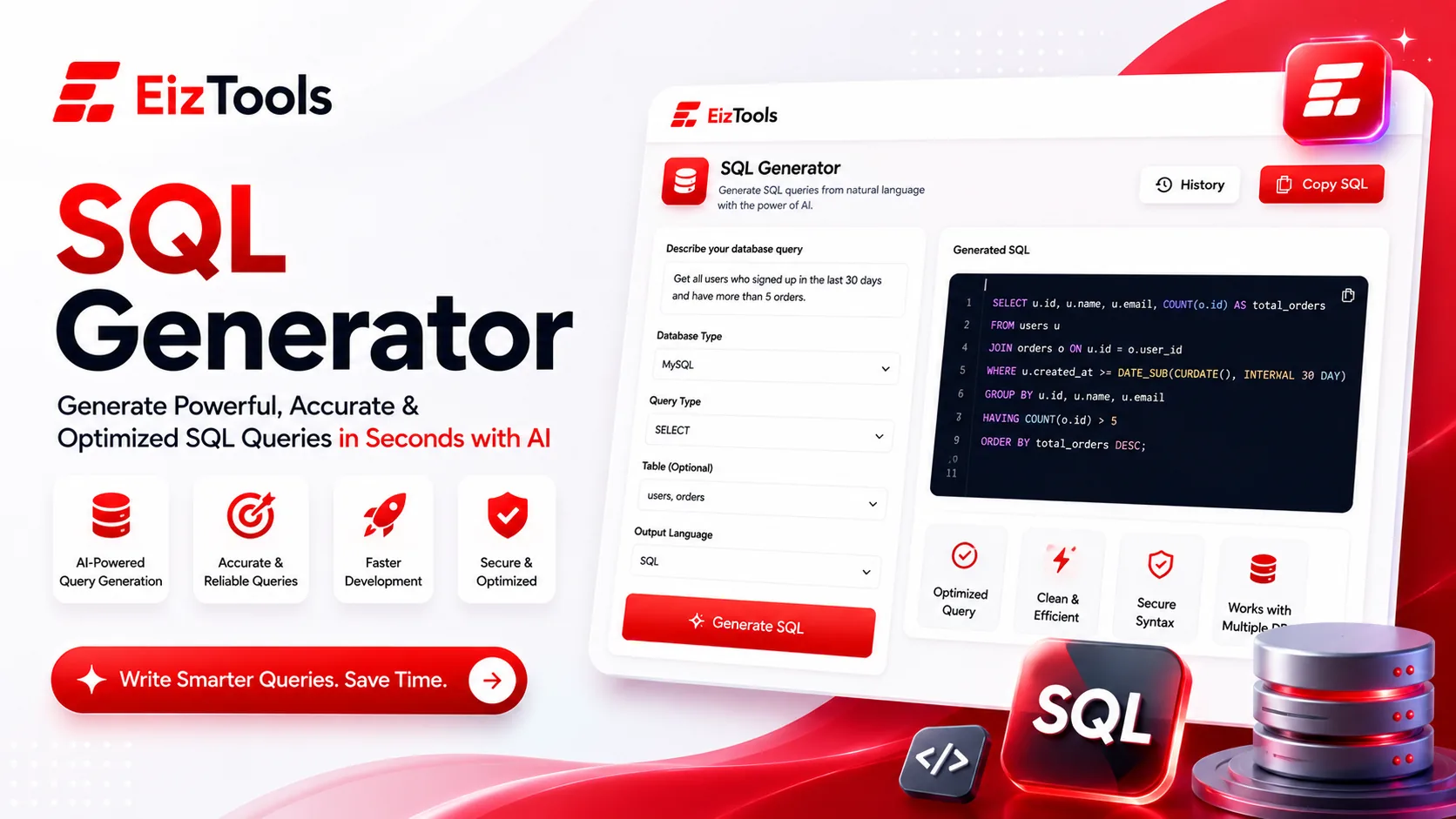
Writing SQL by hand is fine until the joins stack up, the GROUP BY fights back, and a five-minute question turns into half an hour of syntax wrangling. The SQL Generator lets you describe the result you want in plain English and hands back a query that actually runs, so you can get the number, ship the report, or unblock the feature without losing your train of thought to a missing comma or a mismatched parenthesis.
Describe the result, not the syntax
You already know what you are after: last month's revenue by region, the users who churned after a single session, the ten slowest endpoints. The SQL Generator turns that intent into correct, readable SQL, picking the right joins, filters, and aggregates for you. It is the difference between second-guessing whether it is HAVING or WHERE at the end of a long day and simply asking for what you need in a sentence.
Unlike a half-remembered snippet copied from a forum thread, the query is built around the tables and columns you actually name, not a stranger's schema. That matters because the hard part is rarely the logic in your head; it is translating that logic into precise syntax a database will accept without complaint.
What people reach for it to do
- Multi-table joins without hand-tracing every foreign key relationship
- Aggregations and window functions for dashboards and recurring reports
- Data clean-up and one-off migration statements you would rather not write twice
- Turning a vague analytics request from your manager into a concrete, runnable query
- Explaining an inherited query in plain English before you dare to change a line of it
What ties those jobs together is friction. A missing comma, a column referenced before its table is joined, or an aggregate used without a GROUP BY, and the whole thing fails. That friction is exactly when most people give up and paste something fragile from an old project. Removing it means a clear idea does not die on a syntax error.
A quick example
Ask for "the top five customers by total spend this year, with their order count," and you get back something ready to paste straight into your database client:
SELECT c.name,
       COUNT(o.id)  AS orders,
       SUM(o.total) AS total_spend
FROM customers c
JOIN orders o ON o.customer_id = c.id
WHERE o.created_at >= '2026-01-01'
GROUP BY c.name
ORDER BY total_spend DESC
LIMIT 5;
Change a column, adjust the date range, and run it again. You stay in control of the query; the tool just removes the blank-page tax and the silly typos that cost you ten minutes and a bruised ego. When the shape of the answer is close but not perfect, editing generated SQL is far faster than writing it from scratch, because the scaffolding, the joins, and the grouping are already in place.
It is worth reading what comes back rather than trusting it blindly. Because the query stays short and readable, a quick scan tells you whether the join grain is right and whether the date filter does what you actually meant. You pick up a little more each pass, and the queries you could not yet write from a blank editor slowly become ones you can read, adjust, and trust with confidence.
Getting sharper results
- Name your tables and key columns so the output matches your real schema instead of a generic guess.
- Say which database you use, since PostgreSQL, MySQL, and SQL Server disagree on the finer points of syntax.
- Mention the sort order and row limit you expect, or you may get the entire table handed back to you.
- Paste an existing query and ask for an explanation, an index hint, or a faster rewrite.
A minute spent on a precise request saves five spent debugging a vague one. The more context you give about your tables and the shape you want, the closer that first result lands to something you can ship without a second pass.
Questions developers ask
Does it work with my database?
Yes. Tell it whether you are on PostgreSQL, MySQL, SQL Server, SQLite, or another engine, and the generated syntax adapts to that dialect rather than a lowest-common-denominator version that breaks on the first quirk.
Can it explain or fix a query I already have?
It can. Paste the query and ask for a plain-English breakdown or an optimized rewrite. That is a genuine lifesaver when you inherit someone else's reporting logic with zero comments and a deadline attached.
Is it free to use?
Yes, with generous daily limits. Heavier users can unlock unlimited generations and support for longer, more intricate queries that span many tables and subqueries.
Keep it close to the tools it pairs with: reach for the Error Fixer when a query throws something cryptic, or the JSON Prompt Generator when you are feeding database results into an AI workflow and need clean, structured input.

Sabir Bepari
Founder of EizTools and a passionate AI enthusiast dedicated to building practical, user-friendly AI tools that simplify everyday tasks.