




10 Common AI Mistakes Beginners Should Avoid
Avoid common AI mistakes, improve your prompts, build confidence, and get more accurate results from your favorite AI tools every day.
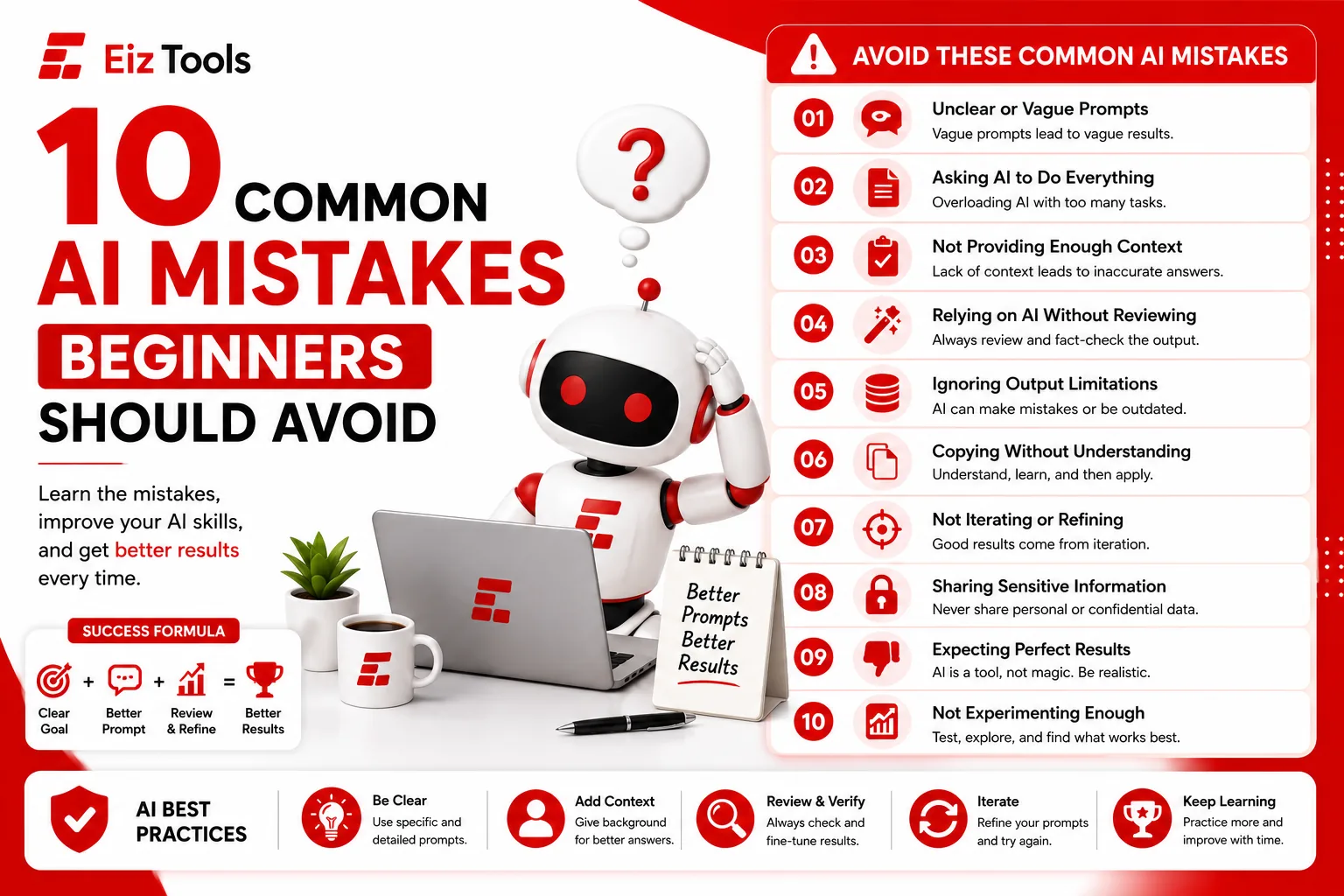
Have you ever asked an AI tool to write something and received a confusing or completely unrelated answer? Have you wondered why other people get amazing results from AI while your responses feel average? If so, you are not alone.
Many people assume artificial intelligence automatically understands what they want. In reality, AI performs best when it receives clear instructions, accurate information, and human guidance. Learning to avoid common AI mistakes can dramatically improve the quality of your results while saving time and reducing frustration.
This guide explains the common AI mistakes beginners should avoid, why these mistakes happen, and how to fix them with practical examples. Whether you use AI for writing, coding, research, business, marketing, education, or daily productivity, these tips will help you work more efficiently and responsibly.
If you want to explore hundreds of productivity, AI, developer, SEO, PDF, image, and business tools, visit EizTools. You can also discover more practical tutorials and learning resources on the EizTools Blog.
What Are Common AI Mistakes?
Common AI mistakes are habits or misunderstandings that reduce the quality, reliability, or usefulness of AI generated results. Most beginners expect AI to think like a human expert, but AI models generate responses by predicting patterns from the information they were trained on and the prompts users provide.
Understanding these limitations helps you become a better AI user. Instead of treating AI as a replacement for human thinking, treat it as an intelligent assistant that works best when guided carefully.
The good news is that nearly all beginner mistakes can be fixed with better prompting, verification, and critical thinking.
Why Beginners Make AI Mistakes
Before looking at the specific mistakes, it helps to understand why they happen in the first place.
- Many users expect AI to know exactly what they mean.
- People often provide incomplete or vague prompts.
- Users trust AI responses without checking facts.
- Some assume every AI tool has the same capabilities.
- Beginners rarely refine prompts after receiving weak answers.
- Many users overlook privacy and security considerations.
Once you recognize these habits, avoiding common AI mistakes becomes much easier.
Common AI Mistake 1: Writing Vague Prompts
The biggest reason beginners receive poor AI responses is because they ask vague questions. AI can only work with the information it receives. If your prompt lacks context, the response will often be generic.
Example of a Weak Prompt
"Write an article about marketing."
This instruction gives almost no direction. The AI does not know the audience, purpose, length, tone, or objective.
Example of a Better Prompt
"Write a 1200 word beginner friendly article about email marketing for small business owners. Include examples, practical tips, and an FAQ section."
The improved prompt gives AI enough information to generate a focused response.
How to Avoid This Mistake
- Explain your goal clearly.
- Mention your audience.
- Specify the desired format.
- Include word count if necessary.
- Describe the tone you want.
- Mention any important topics to include.
The more context you provide, the better AI can assist you.
Common AI Mistake 2: Believing Every AI Response Is Correct
One of the most dangerous common AI mistakes beginners should avoid is assuming every response is accurate. AI can confidently generate incorrect facts, outdated information, or fabricated references.
This issue is often called an AI hallucination. While modern AI systems continue improving, no model is perfect.
Why Verification Matters
- Statistics may be outdated.
- Quotes can be inaccurate.
- Sources may not exist.
- Technical explanations may contain errors.
- Legal or medical information may be incomplete.
Best Practices
- Cross check important facts.
- Verify numerical data.
- Read official documentation when available.
- Use trusted sources for research.
- Review AI generated code before deployment.
AI is an excellent assistant, but human verification remains essential.
Common AI Mistake 3: Asking AI to Do Everything at Once
Many beginners write enormous prompts asking AI to complete an entire project in one response. While AI can handle complex tasks, breaking work into smaller steps usually produces higher quality results.
Instead of asking AI to create an entire business plan, website, marketing strategy, and social media campaign in one prompt, divide the work into manageable tasks.
A Better Workflow
- Create the project outline.
- Generate individual sections.
- Edit each section separately.
- Review accuracy.
- Improve readability.
- Create the final version.
This step by step approach reduces errors and improves overall quality.
Common AI Mistake 4: Ignoring Context
AI performs much better when it understands the background of your request. Beginners often forget to explain who the content is for, why it is needed, or what has already been completed.
For example, asking AI to "write product descriptions" without explaining the products, audience, or brand voice usually produces average content.
Helpful Context to Include
- Target audience.
- Industry.
- Project objective.
- Writing style.
- Brand personality.
- Important keywords.
- Content length.
Providing context allows AI to generate responses that better match your expectations.
Common AI Mistake 5: Never Editing AI Generated Content
Another major beginner mistake is publishing AI generated content exactly as it appears. While AI can create impressive drafts, every response should be reviewed before publication.
Editing improves readability, removes repetition, fixes factual errors, and ensures the content reflects your own expertise and experience.
Always Review These Areas
| Area | What to Check |
|---|---|
| Accuracy | Verify facts, statistics, and names. |
| Grammar | Correct awkward or repetitive sentences. |
| Tone | Match your audience and brand voice. |
| Originality | Add personal insights and examples. |
| Formatting | Improve headings, lists, and readability. |
Think of AI as your first draft assistant rather than your final editor.
By avoiding these first five common AI mistakes, you already place yourself ahead of many new AI users. The remaining mistakes focus on privacy, choosing the right AI tools, prompt improvement, responsible usage, and developing long term AI skills.
Common AI Mistake 6: Sharing Sensitive or Confidential Information
One of the most overlooked common AI mistakes beginners should avoid is entering confidential information into AI tools. While many AI platforms invest heavily in security, you should never assume every conversation is completely private or appropriate for sharing sensitive business or personal data.
Think carefully before copying client documents, passwords, financial records, medical information, legal agreements, or company source code into an AI chatbot.
Information You Should Never Share
- Passwords and authentication codes.
- Bank account or credit card details.
- Personal identification numbers.
- Private customer information.
- Confidential business documents.
- Medical records.
- Unreleased company projects.
Instead, replace sensitive information with placeholders whenever possible. For example, write "Client A" instead of using the client's real name or remove confidential numbers before asking AI to analyze a document.
Practicing good privacy habits protects both you and the people you work with.
Common AI Mistake 7: Using the Wrong AI Tool for the Job
Not every AI application is designed to perform every task. A common beginner mistake is expecting one AI tool to excel at writing, programming, image generation, video editing, document conversion, research, and automation at the same time.
Modern AI tools are becoming more capable, but many still have specific strengths.
| Task | Best Type of AI Tool |
|---|---|
| Writing articles | AI writing assistants |
| Programming help | AI coding assistants |
| Image creation | AI image generators |
| Research support | AI research assistants |
| Language translation | AI translation tools |
| Productivity workflows | AI automation platforms |
Choosing the right tool improves both accuracy and efficiency. Before starting a project, understand what your selected AI application is specifically designed to accomplish.
Common AI Mistake 8: Accepting the First Response
Many beginners assume the first answer from AI is the best answer. In reality, experienced users often improve results through multiple revisions.
AI conversations work much like collaborating with another person. Instead of starting over, continue the conversation and ask the AI to improve its response.
Examples of Helpful Follow Up Prompts
- Make this easier to understand.
- Add more practical examples.
- Rewrite this for beginners.
- Expand the conclusion.
- Shorten each paragraph.
- Explain this in simple language.
- Create a comparison table.
Prompt refinement is one of the fastest ways to improve AI generated content. Even small changes to your instructions can significantly improve the final output.
Common AI Mistake 9: Depending Entirely on AI
Artificial intelligence is a powerful assistant, but it should not replace human creativity, judgment, or decision making.
Some beginners begin relying on AI for every task without developing their own understanding of the subject. This habit can reduce critical thinking and make it difficult to identify incorrect information.
The best approach is collaboration.
- Use AI to brainstorm ideas.
- Let AI create first drafts.
- Edit content using your expertise.
- Add personal experiences.
- Verify important information.
- Make the final decisions yourself.
Combining human knowledge with AI assistance consistently produces stronger results than relying entirely on either one alone.
Common AI Mistake 10: Not Learning Prompt Engineering Basics
Many beginners think prompt engineering is only for technical experts. In reality, understanding how to communicate with AI is becoming an increasingly valuable skill across many industries.
Prompt engineering simply means giving AI clear, structured instructions that produce better results.
Elements of an Effective Prompt
- Define the objective.
- Specify the audience.
- Choose the desired tone.
- Provide background information.
- Mention formatting requirements.
- State any limitations.
- Request revisions when necessary.
Learning these simple techniques helps beginners avoid many common AI mistakes while producing more useful, consistent, and professional outputs.
Quick Checklist to Avoid Common AI Mistakes
Before submitting any prompt, review this checklist.
| Question | Yes or No |
|---|---|
| Did I clearly explain my goal? | □ |
| Did I provide enough context? | □ |
| Did I choose the appropriate AI tool? | □ |
| Will I verify important facts? | □ |
| Have I removed sensitive information? | □ |
| Will I edit the final output? | □ |
| Am I prepared to refine the prompt? | □ |
Following this simple checklist before every AI session will improve both the quality of your work and your overall experience.
Benefits of Avoiding Common AI Mistakes
Developing good AI habits delivers long term advantages regardless of your profession or experience level.
- Higher quality AI responses.
- Better productivity.
- More accurate research.
- Improved writing quality.
- Safer handling of private information.
- Greater confidence when using AI tools.
- Less time spent correcting errors.
- Better collaboration between humans and AI.
As AI technology continues evolving, users who understand these best practices will consistently achieve better outcomes than those who rely solely on basic prompts.
Comparison Table of Good AI Habits vs Common AI Mistakes
| Common AI Mistake | Better Practice | Expected Result |
|---|---|---|
| Writing vague prompts | Provide clear goals and context. | More accurate responses. |
| Trusting every answer | Verify important facts. | Higher reliability. |
| Requesting everything at once | Break work into smaller tasks. | Better quality output. |
| Ignoring context | Explain the audience and objective. | Relevant content. |
| Publishing without editing | Review and improve the response. | Professional results. |
| Sharing confidential data | Remove sensitive information. | Improved privacy. |
| Using the wrong AI tool | Select tools based on the task. | Greater efficiency. |
| Accepting the first response | Refine prompts and request revisions. | Higher quality answers. |
| Depending only on AI | Combine AI with human expertise. | More trustworthy work. |
| Ignoring prompt engineering | Learn structured prompting techniques. | Consistent results. |
Best Practices for Getting Better AI Results
Now that you understand the common AI mistakes beginners should avoid, it helps to build a workflow that consistently produces better results. These habits apply whether you use AI for writing, studying, coding, marketing, design, or business.
- Start with a clear objective before writing your prompt.
- Provide enough background information for the AI to understand your request.
- Choose the right AI tool for the specific task.
- Use examples whenever possible.
- Review important facts before publishing.
- Refine your prompts instead of starting over.
- Edit every AI generated response to match your own voice.
- Protect personal and confidential information.
- Continue learning as AI technology evolves.
- Use AI as an assistant rather than a replacement for critical thinking.
These simple practices can dramatically improve the quality of your work while helping you use artificial intelligence more responsibly.
Frequently Asked Questions
What is the biggest AI mistake beginners make?
The most common mistake is writing vague prompts without enough context. Clear instructions usually produce significantly better results.
Can AI generate incorrect information?
Yes. AI systems can occasionally produce inaccurate or outdated information. Important facts should always be verified using reliable sources.
Should I edit AI generated content?
Absolutely. AI is excellent for creating drafts, but editing improves clarity, accuracy, originality, and consistency with your own writing style.
Is it safe to share personal information with AI?
You should avoid sharing passwords, financial details, confidential business information, medical records, or other sensitive data unless you fully understand the platform's privacy practices.
Do I need prompt engineering skills?
Basic prompt writing skills are useful for everyone. Learning how to provide clear instructions helps AI deliver more accurate and relevant responses.
Can AI replace human expertise?
No. AI is a powerful productivity tool, but human judgment, creativity, experience, and fact checking remain essential for producing trustworthy work.
How can beginners improve their AI skills?
Practice writing better prompts, experiment with different AI tools, verify important information, and continuously refine your workflow based on the results you receive.
Artificial intelligence has transformed the way people learn, create, solve problems, and complete everyday tasks. However, achieving great results requires more than simply opening an AI tool and asking a question. Understanding the common AI mistakes beginners should avoid allows you to work smarter, save time, and produce more reliable outcomes.
Remember that AI performs best when you provide clear instructions, verify important information, protect sensitive data, and review every response before using it. As your prompting skills improve, you will notice a significant difference in the quality of the answers you receive.
The future belongs to people who know how to combine human creativity with artificial intelligence responsibly. By building good habits today, you will be better prepared to take advantage of new AI technologies as they continue to evolve.
Thank you for taking the time to read this guide. We hope it helps you avoid common beginner mistakes and use AI with greater confidence.
If you enjoyed this article, explore more free online tools, AI resources, productivity utilities, developer tools, PDF tools, SEO tools, calculators, converters, and practical tutorials on EizTools. Stay connected by following us on our social media channels, subscribing to our newsletter, and enabling push notifications so you never miss new tools, tutorials, feature updates, and expert guides designed to help you work smarter every day.

Sabir Bepari
Founder of EizTools and a passionate AI enthusiast dedicated to building practical, user-friendly AI tools that simplify everyday tasks.
Join the Newsletter
Get the best new AI tools and tips delivered to your inbox. No spam.
By subscribing you agree to receive emails from EizTools. Unsubscribe anytime.
Follow EizTools
Discussion 0
Join the conversation — share your thoughts, ask questions, help others.
No comments yet. Be the first to share your thoughts!