






Workflow Automation Tools for Beginners
Automate repetitive tasks with beginner friendly tools that save time, improve efficiency, simplify workflows, and boost everyday productivity effortlessly today.
Do you find yourself copying data between apps, sending the same emails repeatedly, updating spreadsheets manually, or forgetting routine tasks? If so, you're not alone. Many individuals, freelancers, students, and small businesses spend hours every week on work that can easily be automated.
The good news is that you don't need programming knowledge to automate everyday work. Modern workflow automation tools for beginners make it easy to connect your favorite apps, eliminate repetitive tasks, and save valuable time with simple drag and drop interfaces.
In this guide, you'll learn what workflow automation tools are, why they matter, how they work, the best beginner friendly options, practical examples, common mistakes to avoid, and tips to start automating your daily work with confidence.
Eiztools is dedicated to helping users discover practical productivity solutions, software recommendations, and free online tools that simplify everyday work. Visit Eiztools for more productivity resources and tool guides.
What Are Workflow Automation Tools for Beginners?
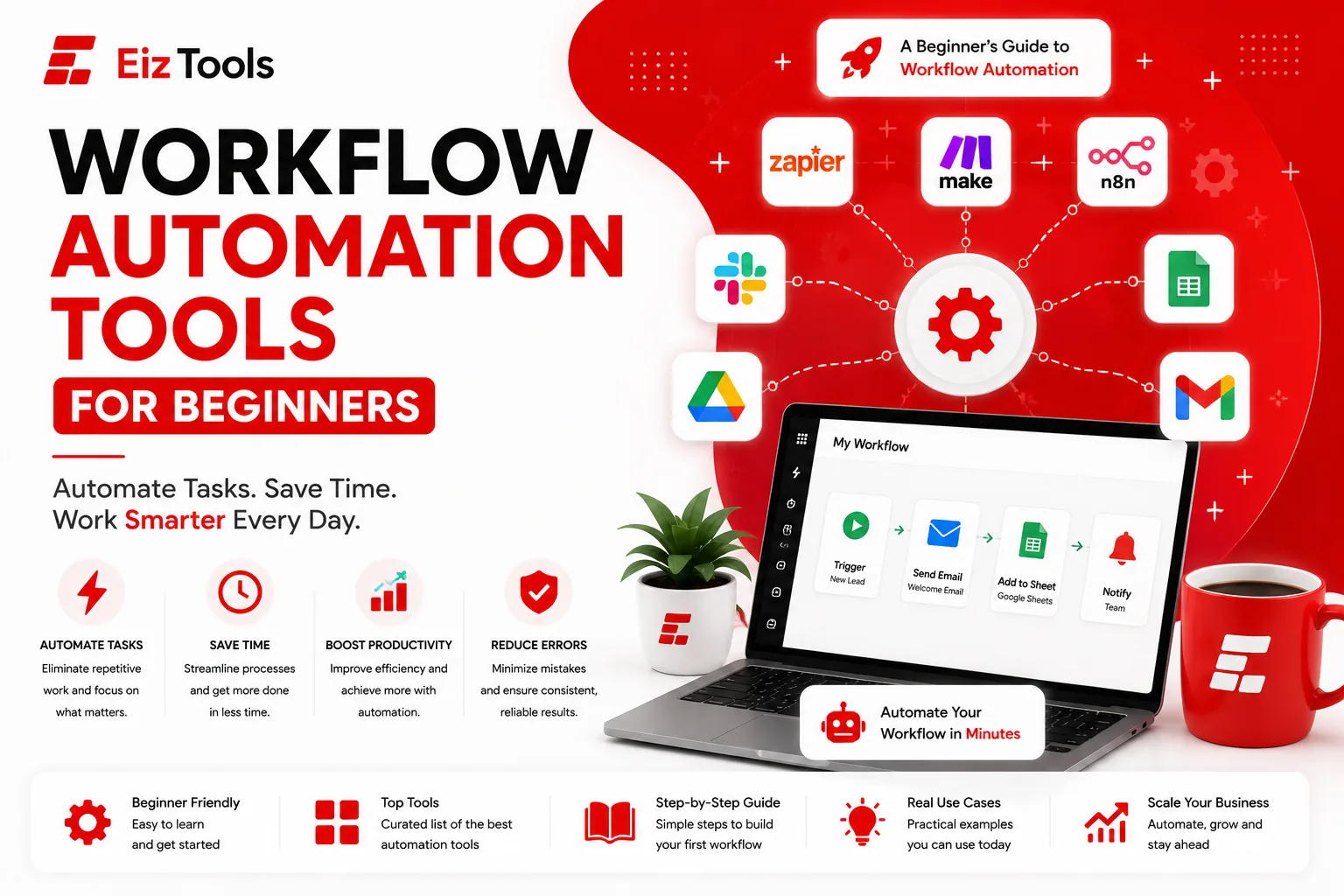
Workflow automation tools for beginners are applications that automatically perform repetitive tasks based on predefined rules or triggers. Instead of completing the same process manually every day, you create an automation once, and the software handles the work for you.
For example, instead of downloading email attachments manually and uploading them into cloud storage, an automation tool can instantly save every attachment to your preferred folder whenever a new email arrives.
These tools generally work using a simple pattern:
- A trigger starts the workflow.
- The automation processes the required information.
- One or more actions are completed automatically.
Most modern automation platforms provide visual workflow builders, making them suitable even for complete beginners.
Why Beginners Should Use Workflow Automation Tools
Automation is no longer limited to large enterprises. Students, creators, freelancers, startups, marketers, and small business owners can all benefit from simple workflow automation.
- Save hours every week.
- Reduce repetitive manual work.
- Improve accuracy by minimizing human errors.
- Increase productivity without hiring additional staff.
- Keep information synchronized across multiple apps.
- Automatically organize files and documents.
- Respond faster to customers.
- Create consistent business processes.
Once you become familiar with workflow automation tools for beginners, you'll likely discover dozens of repetitive tasks that can be automated in just a few minutes.
How Workflow Automation Tools Work
Although every platform looks different, most automation tools follow the same basic workflow.
- Trigger — An event occurs, such as receiving an email.
- Condition — The workflow checks whether specific criteria are met.
- Action — The automation performs one or more tasks automatically.
Example workflow:
| Step | Example |
|---|---|
| Trigger | New customer submits a contact form |
| Condition | Email address is valid |
| Action 1 | Create a CRM contact |
| Action 2 | Send a welcome email |
| Action 3 | Notify the sales team |
Features to Look for in Workflow Automation Tools for Beginners
Choosing your first automation platform becomes much easier when you know which features matter most.
- Visual workflow builder
- Drag and drop editor
- No coding required
- Large collection of app integrations
- Prebuilt workflow templates
- Error notifications
- Conditional logic
- Scheduling options
- Cloud based automation
- Affordable free plan
- Detailed activity history
- Easy onboarding tutorials
Best Workflow Automation Tools for Beginners
The market offers dozens of automation platforms, but beginners should focus on solutions that prioritize simplicity and excellent documentation.
| Tool | Best For | Coding Required | Free Plan |
|---|---|---|---|
| Zapier | General business automation | No | Yes |
| Make | Visual workflow building | No | Yes |
| Microsoft Power Automate | Microsoft ecosystem users | No | Limited |
| IFTTT | Personal automation | No | Yes |
| n8n | Advanced customization | Optional | Yes |
| Pipedream | Developer friendly workflows | Optional | Yes |
Each platform offers different strengths, but beginners should prioritize ease of use over advanced capabilities during the learning phase.
Common Workflow Automation Examples
Understanding practical examples makes it easier to see where automation fits into everyday work.
Email Management
- Automatically label incoming emails.
- Forward important emails to teammates.
- Save attachments to cloud storage.
- Create reminders from flagged emails.
Marketing
- Publish blog posts across social media.
- Send welcome emails automatically.
- Track marketing leads.
- Update CRM contacts.
Sales
- Create invoices automatically.
- Notify sales representatives about new leads.
- Schedule follow up emails.
- Generate customer reports.
Content Creation
- Store article drafts.
- Create project tasks automatically.
- Publish approved content.
- Share updates with editors.
Personal Productivity
- Organize calendar events.
- Back up important files.
- Track daily habits.
- Create reminders automatically.
Industries That Benefit from Workflow Automation
Almost every profession can use automation to simplify repetitive work.
| Industry | Automation Example |
|---|---|
| Education | Student notifications |
| Healthcare | Appointment reminders |
| Ecommerce | Order confirmations |
| Marketing | Lead nurturing |
| Finance | Invoice processing |
| Human Resources | Employee onboarding |
| Customer Support | Ticket routing |
| Project Management | Task assignment |
How to Choose the Right Workflow Automation Tool
Selecting the right platform depends on your goals rather than the number of available features. Beginners should focus on software that is easy to learn and supports the applications they already use.
- Identify repetitive tasks first.
- List the apps you use daily.
- Compare available integrations.
- Start with the free version.
- Choose a visual workflow builder.
- Read community documentation.
- Scale gradually as your needs grow.
If you're exploring more productivity software recommendations, browse additional guides available on the Eiztools Blog.
Workflow Automation Tools for Beginners in Everyday Life
One of the biggest advantages of workflow automation is that it is useful far beyond business environments. Whether you are a student, freelancer, content creator, or entrepreneur, automating repetitive tasks can help you focus on work that requires creativity and decision making.
Many beginners start with just one simple workflow and gradually build dozens of automations as they become more comfortable using automation platforms.
For Students
- Save lecture notes automatically to cloud storage.
- Create calendar reminders for assignment deadlines.
- Receive notifications when new course materials are uploaded.
- Organize research documents into folders automatically.
For Freelancers
- Create invoices after project completion.
- Send welcome emails to new clients.
- Track project inquiries in a spreadsheet.
- Receive payment notifications instantly.
For Small Businesses
- Collect customer inquiries automatically.
- Assign leads to sales representatives.
- Generate follow up emails.
- Keep inventory records updated.
For Content Creators
- Publish content across multiple social platforms.
- Receive notifications when videos go live.
- Organize media files automatically.
- Track publishing schedules.
Step by Step Guide to Using Workflow Automation Tools for Beginners
If you are completely new to automation, don't try to automate everything at once. Start with one repetitive task and gradually expand your workflows.
- Identify a task you repeat every day.
- Select an automation platform that supports your favorite applications.
- Connect the required accounts securely.
- Create a trigger that starts the workflow.
- Add one or more automated actions.
- Test the workflow using sample data.
- Enable the automation.
- Monitor results and improve the workflow over time.
This gradual approach helps beginners understand automation concepts without becoming overwhelmed.
Popular Workflow Automation Categories
The best workflow automation tools for beginners support hundreds or even thousands of applications across different categories.
| Category | Typical Automation |
|---|---|
| Forward, organize, and archive emails | |
| Cloud Storage | Automatically back up files |
| Project Management | Create and assign new tasks |
| CRM | Add new customer records |
| Accounting | Create invoices and payment records |
| Communication | Send notifications to teams |
| Marketing | Manage campaigns automatically |
| Calendar | Create meetings and reminders |
Benefits of Workflow Automation Tools for Beginners
Learning automation offers both immediate and long term benefits. Even small improvements can save hours every month.
- Improve personal productivity.
- Reduce manual errors.
- Save valuable working hours.
- Create consistent business processes.
- Increase operational efficiency.
- Improve customer response time.
- Reduce repetitive administrative work.
- Scale business operations more easily.
- Organize digital information automatically.
- Focus more on creative and strategic work.
Common Beginner Mistakes to Avoid
Many new users become excited about automation and attempt to automate everything immediately. A more practical approach is to start small and build confidence over time.
- Creating overly complicated workflows.
- Ignoring workflow testing.
- Using unnecessary automation steps.
- Connecting too many applications at once.
- Not monitoring failed workflows.
- Skipping documentation.
- Using automation without reviewing permissions.
- Automating tasks that rarely occur.
A simple automation that works consistently is far more valuable than a complicated workflow that frequently fails.
Best Practices for Workflow Automation Success
Following proven practices will help you build reliable and efficient workflows from the beginning.
- Document every important workflow.
- Use descriptive workflow names.
- Review automations regularly.
- Remove outdated workflows.
- Keep sensitive information secure.
- Use folders to organize automations.
- Enable notifications for workflow failures.
- Test changes before publishing.
- Monitor automation performance.
- Update integrations when required.
Workflow Automation Use Cases Across Business Departments
| Department | Automation Use Case | Main Benefit |
|---|---|---|
| Sales | Lead assignment | Faster follow ups |
| Marketing | Email campaigns | Improved engagement |
| Finance | Invoice creation | Reduced manual work |
| Support | Ticket routing | Quicker responses |
| Human Resources | Employee onboarding | Consistent processes |
| Operations | Approval workflows | Better efficiency |
| Management | Performance reporting | Better decision making |
Is Learning Workflow Automation Worth It?
Absolutely. Automation has become one of the most valuable digital skills across nearly every industry. Organizations increasingly rely on automated processes to reduce costs, improve efficiency, and deliver faster services.
Learning workflow automation tools for beginners today can improve your productivity, strengthen your technical skills, and make everyday work significantly easier. As automation platforms continue to evolve with artificial intelligence and smarter integrations, beginners who start now will have a strong foundation for future workplace technologies.
In the final part of this guide, we'll explore advanced tips, compare manual work versus automation, answer frequently asked questions, and summarize everything you need to confidently begin your automation journey.
Advanced Tips for Getting the Most from Workflow Automation Tools for Beginners
Once you've created a few successful workflows, you can gradually improve them by adding conditions, filters, and multiple actions. The goal is not to build the most complex automation but to create reliable workflows that consistently save time.
- Begin with one workflow before creating additional automations.
- Use descriptive names so workflows are easy to identify.
- Group similar automations into folders or categories.
- Review workflows every few months and remove outdated ones.
- Keep app permissions updated for better security.
- Test every workflow after making changes.
- Monitor automation history to identify failures quickly.
- Create backup processes for critical business workflows.
Manual Work vs Workflow Automation Tools for Beginners
| Manual Process | Automated Process |
|---|---|
| Repeated data entry | Automatic data synchronization |
| Sending emails individually | Emails sent automatically |
| Copying files manually | Instant cloud backups |
| Updating spreadsheets by hand | Real time data updates |
| Remembering routine tasks | Automatic reminders |
| Creating reports manually | Scheduled report generation |
| Assigning work manually | Automatic task assignment |
| Following up with customers | Automated follow up messages |
As this comparison shows, even simple automation can remove repetitive work and improve consistency across personal and professional tasks.
Frequently Asked Questions About Workflow Automation Tools for Beginners
What are workflow automation tools?
Workflow automation tools are software platforms that perform repetitive tasks automatically based on predefined triggers, conditions, and actions.
Do I need coding skills to use workflow automation tools?
No. Most beginner friendly automation platforms provide visual builders that allow users to create workflows using drag and drop interfaces without writing code.
Which workflow automation tool is best for beginners?
Many beginners choose Zapier, Make, Microsoft Power Automate, or IFTTT because they offer simple interfaces, templates, and extensive documentation.
Can workflow automation save time?
Yes. Even basic workflows can save several hours every week by eliminating repetitive manual tasks such as sending emails, updating spreadsheets, and organizing files.
Are workflow automation tools secure?
Reputable automation platforms use encryption and secure authentication. Always review permissions carefully and enable additional security features such as two factor authentication whenever available.
Can small businesses benefit from workflow automation?
Absolutely. Small businesses can automate customer communication, lead management, invoicing, file organization, appointment scheduling, and many other daily operations.
Can I automate personal tasks?
Yes. Personal automation can include calendar reminders, cloud backups, smart home actions, note organization, email management, and habit tracking.
How should beginners start with workflow automation?
Start by identifying one repetitive task, automate it successfully, and then gradually build additional workflows as your confidence grows.
Learning workflow automation tools for beginners is one of the smartest investments you can make in your productivity. Instead of spending valuable time on repetitive work, automation allows you to focus on solving problems, serving customers, creating content, and growing your career or business.
The key to success is starting small. Choose a simple task, automate it, evaluate the results, and expand your workflows step by step. As your experience grows, you'll discover countless opportunities to streamline everyday work while reducing errors and improving efficiency.
Whether you're a student, freelancer, entrepreneur, marketer, or business owner, workflow automation is no longer a luxury. It has become an essential digital skill that helps people work smarter rather than harder.
Thank you for taking the time to read our complete guide on workflow automation tools for beginners. We hope this article helps you start building smarter workflows and improve your daily productivity.
To discover more free online tools, practical tutorials, productivity guides, and technology resources, continue exploring Eiztools. We also invite you to follow Eiztools on social media, subscribe to our newsletter, and enable push notifications so you'll be among the first to receive updates on new tools, feature releases, and expert guides designed to help you work more efficiently.

Sabir Bepari
Founder of EizTools and a passionate AI enthusiast dedicated to building practical, user-friendly AI tools that simplify everyday tasks.
Join the Newsletter
Get the best new AI tools and tips delivered to your inbox. No spam.
By subscribing you agree to receive emails from EizTools. Unsubscribe anytime.
Follow EizTools
Discussion 0
Join the conversation — share your thoughts, ask questions, help others.
No comments yet. Be the first to share your thoughts!