















Poem Generator
Verses that mirror your mood
 NVIDIA: Nemotron 3 Ultra (free)





Your prompt will appear here…
Your beautifully formatted article will appear here once you generate.
No history yet
Your generations will appear here. Sign in to save them permanently.
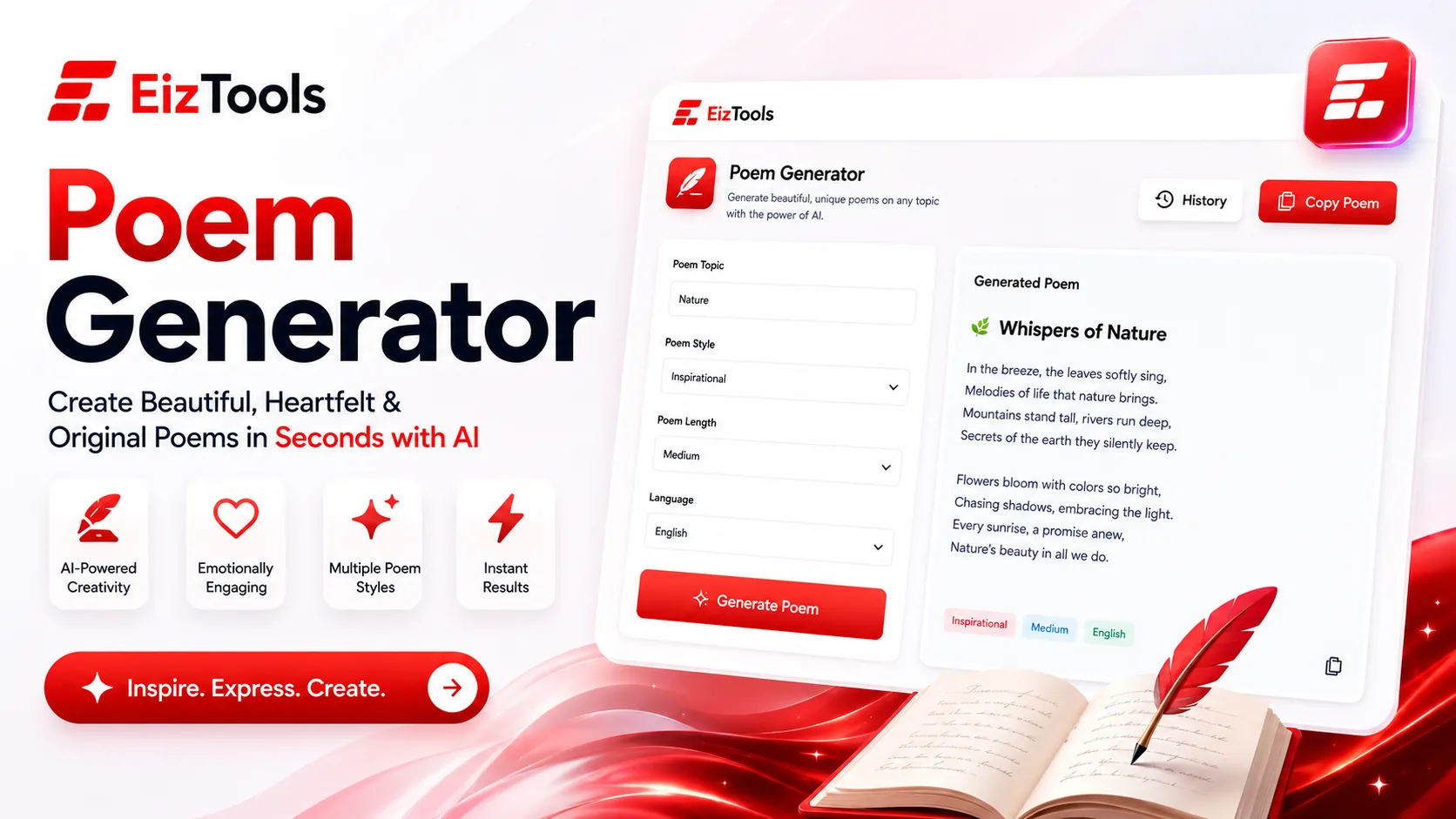
A blank page is intimidating; a first line rarely is. The Poem Generator hands you that opening line — and the shape the rest wants to grow into — whether you need fourteen measured lines for an anniversary or three spare images to tuck beside a photograph. Give it a subject, a form, and a mood, and it returns an original poem built to those specifications, ready to keep as written or reshape until it sounds unmistakably like you.
Poems for every style
Plenty of writing tools do one thing well. This one is closer to a well-stocked workshop: it moves between strict traditional forms and loose modern ones, between playful and elegiac, between four lines and forty. You can name a rhyme scheme, request a syllable count, or simply describe the occasion and let the Poem Generator pick a form that fits. What follows is a short tour of what it produces and when each shape earns its place.
A tour of styles and forms
The sonnet, for occasions that deserve weight
Fourteen lines, a turn of thought near the end, and a closing couplet that lands like a signature — the sonnet is made for moments you want to feel permanent. Ask for one to mark a fortieth birthday or a retirement and you get something with the cadence of a toast, resolving on a line worth reading aloud twice.
The haiku, for a single clear image
When less is the whole point, the seventeen-syllable haiku distills a scene to its essence. Feed it "first commute after the baby was born" and it might answer with dark train windows, a reflected face, and the strange new weight of an empty car seat — three lines, no wasted breath. These are ideal for captions, journal margins, or a message that says far more than "good morning."
Free verse, for feeling over form
Some subjects resist rhyme. Grief, a city at dawn, the end of a long friendship — these often want the open field of free verse, where line breaks do the work that meter cannot.
The kettle still clicks off at six / out of habit, / and I let it, / because the sound is one of the few things / that didn't leave.
Reach for this mode when you want honesty over polish, and when a strict pattern would feel like a costume.
Light verse and limericks, for the roast
Not every poem should make people cry. Ask for a limerick about a coworker who never refills the coffee, and the Poem Generator leans into bounce and punchline — perfect for office cards, farewell toasts, and group chats. Rhyming quatrains hit the same warm, teasing register when you want funny without a limerick's slightly cheeky reputation.
The acrostic, for a name worth spelling out
Give it a name and the acrostic threads that name down the left margin, each letter opening a line that describes the person behind it. It is a small structural trick with an outsized effect on a birthday card, a wedding place setting, or a note slipped to a teacher on the last day of term.
The ballad, for a story with a beat
When you have an actual tale to tell — how two people met, the summer everything changed — the ballad's rolling stanzas carry narrative the way a song does. It is the natural bridge between poem and lyric, and a fine warm-up if you are heading toward music anyway.
Set the mood, not just the form
Form is the skeleton; mood is the pulse. The same subject comes back tender, wry, triumphant, or wistful depending on what you ask for. Request a poem about the ocean "in awe" and it reaches for scale and silence; ask for the same ocean "melancholy" and the tide starts sounding like something leaving for good. Stack instructions freely — a hopeful free-verse piece for a graduation, a mischievous rhyming one for an April Fools' card — and the tool balances them into a single coherent poem rather than a compromise.
Where these poems get used
People carry these poems into real life more than you might guess. They become vow-adjacent readings, eulogy openers, tattoo shortlists, dedication pages, and the centerpiece of a handmade card. If you are writing for a celebration and want the spoken version too, the Wedding Speech Writer picks up where a short poem leaves off, and anyone chasing a chorus rather than a stanza can move straight to the Song Lyric Generator to set words to a genre and a beat.
Getting a poem worth keeping
The best results come from specifics. "A poem about my dad" is a fine start; "a rhyming poem about my dad's Sunday pancakes and his terrible jokes, warm and a little funny" gives the Poem Generator something to hold onto. Name the form when you have a preference, name the feeling always, and drop in one true detail — a place, an object, an inside phrase — that no template could ever guess. Then treat the first draft as clay: regenerate a stanza you do not love, ask for a softer ending, or request a tighter version at half the length. Two or three passes usually turn a good poem into the exact one you meant to write.

Sabir Bepari
Founder of EizTools and a passionate AI enthusiast dedicated to building practical, user-friendly AI tools that simplify everyday tasks.