
Brand Positioning Statement
AI Brand Strategy Tool
 NVIDIA: Nemotron 3 Ultra (free)





Your prompt will appear here…
Your beautifully formatted article will appear here once you generate.
No history yet
Your generations will appear here. Sign in to save them permanently.
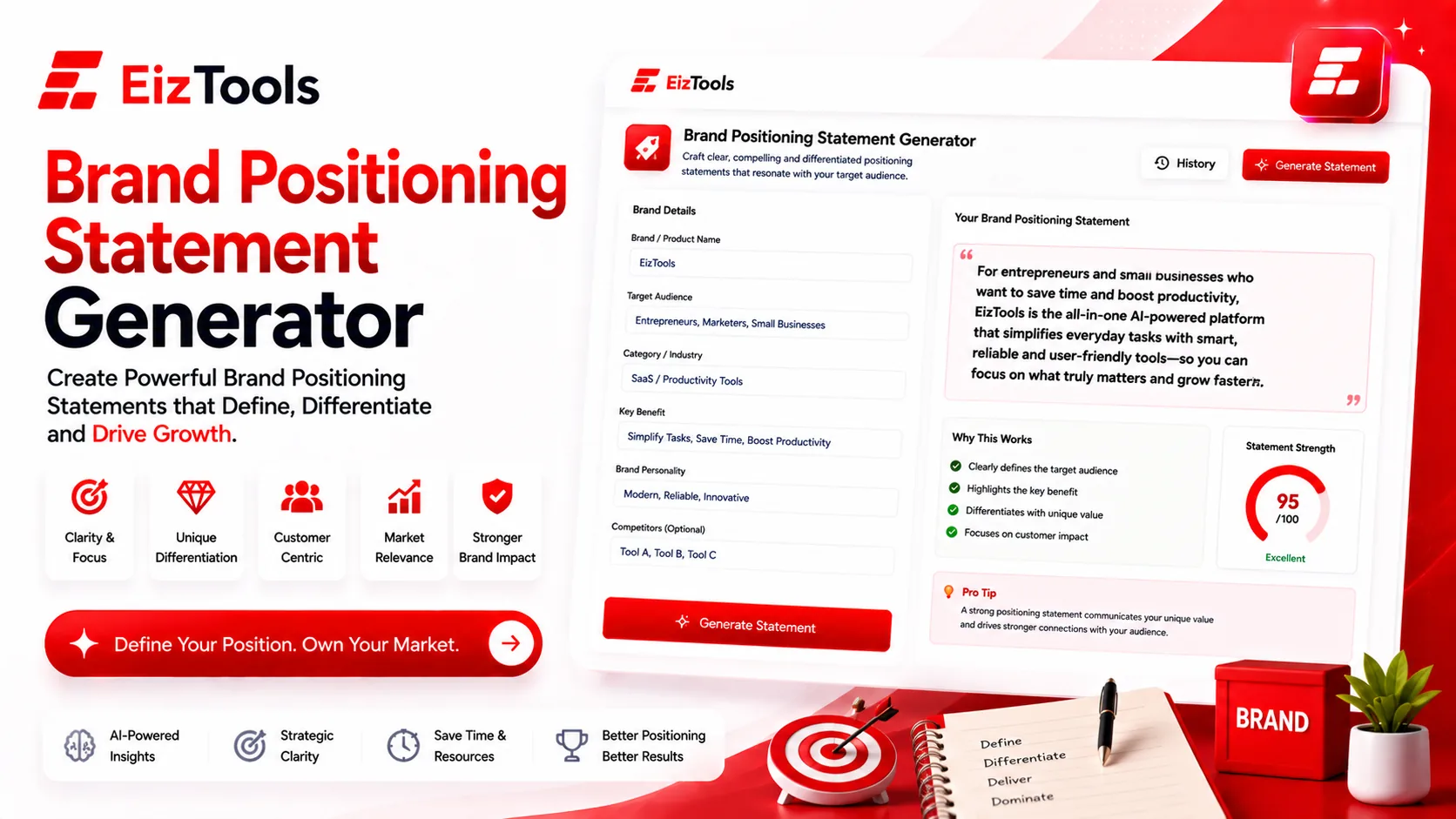
If you have never written one before, the phrase can sound like consultant jargon for something you will never actually use. It is the opposite. A positioning statement is one short, internal sentence that captures who your product is for, what kind of thing it is, the single benefit that matters most, and why anyone should believe you over the alternatives. You rarely show it to a customer. Instead it sits behind everything you do show them — your homepage, your ads, the way you answer "so what do you do?" at a dinner table.
This guide walks a first-timer through what the statement is, why it quietly steers so many decisions, and how the Brand Positioning Statement tool helps you draft one without freezing at a blank page.
What positioning actually means
Positioning is not your logo, your tagline, or your mission. It is the space your brand occupies in a customer's mind relative to every other option — including the option of doing nothing at all. When someone thinks "the cheap flight app" or "the notebook serious writers swear by," that shorthand is your position. You either choose it on purpose or let the market hand you one by accident.
A positioning statement writes that choice down. It is deliberately narrow: one audience, one category, one lead benefit, one reason to believe. Beginners often resist the narrowness, afraid they will shut someone out. That fear is backwards. A statement built to appeal to everyone lands with no one, because the reader cannot tell whether it was meant for them.
Why it steers decisions
The real payoff is that the sentence becomes a filter for the hundred small choices that follow. Should the headline lead with price or with speed? Does this feature belong on the roadmap? Is this the right influencer, the right tone of voice? Hold each question against your positioning and most of them answer themselves.
Without that anchor, teams drift. Marketing promises one thing, the product delivers another, sales invents a third pitch on every call, and customers end up unsure what you even are. Confused people do not buy. A written Brand Positioning Statement keeps everyone aimed at the same target, which is why founders often draft one before they have a logo — or even a finished name. If you are naming the business at the same time, the audience and benefit you pin down here are exactly the raw material a good Business Name Generator run turns into candidates that actually mean something.
The four building blocks
Every positioning statement is assembled from the same four parts. Make each one specific and the sentence very nearly writes itself.
Your target audience
Name the narrow group you are genuinely the best choice for, not "everyone with a pulse." "Freelance wedding photographers" beats "creative professionals." The tighter you draw the audience, the sharper every other part becomes.
The category you compete in
Tell the reader what kind of thing you are, so their brain has a shelf to file you on. "Project management app," "meal-kit service," "budgeting course." Skip this and people have nothing to compare you against, which means they cannot decide.
The benefit that matters most
Pick the single outcome your audience cares about above all the rest — the one they would truly miss if you disappeared. This is a payoff, not a feature list. "Get paid in days, not weeks" beats "automated invoicing with reminders."
What sets you apart
Finish with the reason to believe: the differentiator that makes your benefit credible and hard for rivals to copy. This is the "because" that stops the whole statement from being a claim any competitor could make word for word.
The classic formula
Once you have the four blocks, you drop them into a template that has anchored brand strategy for decades. The skeleton and a worked example look like this:
For [target audience], [brand] is the [category]
that [key benefit] because [reason to believe].

For busy freelancers, Kithe is the invoicing app
that gets you paid in days, not weeks, because it
chases late clients automatically so you never have to.
You do not have to force your own words into that shape by hand. Describe the business in plain language and the Brand Positioning Statement tool sorts your details into the four slots, tightens the wording, and hands back a clean sentence to react to. Reacting is far easier than inventing — you will know at once whether "the invoicing app" should really be "the invoicing app for creatives," then regenerate until it fits.
Common beginner mistakes
A handful of traps catch almost everyone on a first attempt. Watch for these before you settle on a final draft:
- Vague audience: "small businesses" is a market, not a target. Narrow it until it feels slightly uncomfortable.
- Stacking benefits: three "key" benefits means none is key. Choose the one that would hurt most to lose.
- A differentiator that isn't: "great support" and "high quality" are table stakes, not reasons to believe. Find something a rival would struggle to say honestly.
- Writing for the boardroom: the statement is a compass, not ad copy. Plain and true beats clever and hollow.
Using it across your brand
Once the sentence feels right, it stops being a document and becomes something you use every week. Pin it where the team can see it and run each new decision past it. When you write the homepage, the statement tells you exactly what the headline must promise — hand it to the Landing Page Copywriter so the words above the fold echo the same audience, category, and benefit instead of drifting into slogans nobody remembers. When you brief a designer or an ad platform, one tidy paragraph aligns them faster than any deck.
Revisit it whenever the business shifts — a new audience, a sharper benefit, a competitor who copied your old angle. The best Brand Positioning Statement is not the one you frame on a wall and forget; it is the living sentence that keeps your marketing, your product, and your team pointed at one promise, so everything a customer sees tells a single, coherent story.

Sabir Bepari
Founder of EizTools and a passionate AI enthusiast dedicated to building practical, user-friendly AI tools that simplify everyday tasks.