Prompt Optimizer
Refine any prompt for clearer, stronger AI results
 gpt-4o-mini


Your prompt will appear here…
Your beautifully formatted article will appear here once you generate.
No history yet
Your generations will appear here. Sign in to save them permanently.
Have you ever typed a prompt into an AI model, hit enter, and then stared at a response that was… fine, but not quite right? Maybe too vague, too wordy, or just missing the spark you were looking for. The truth is, even powerful AI models are only as good as the prompts they receive. That's where the AI Prompt Optimizer steps in — a dedicated tool built to turn ordinary, rough-draft prompts into precise, high-performing instructions that get AI to do exactly what you actually need.
Whether you're a writer refining a creative brief, a developer drafting a system instruction, or a marketer trying to get sharp ad copy from ChatGPT, the quality of your prompt is the single biggest lever you control. The AI Prompt Optimizer takes what you have and makes it genuinely better — structured, clear, and tuned to your chosen AI model.
Quick Answer: The AI Prompt Optimizer is a free tool on EizTools that rewrites, expands, simplifies, or restructures your raw prompts so they produce stronger, more accurate results from AI models like ChatGPT, Claude, Gemini, Grok, and Midjourney. Paste your idea, pick your optimization goal, choose your target model, and get a polished prompt ready to use in seconds.
How the AI Prompt Optimizer Turns Rough Ideas Into Precision Instructions
Getting the most out of this tool means understanding the full workflow from start to finish. It's a straightforward process, but each step is meaningful — the advanced options in particular make a real difference in what you get back.
Start With Your Prompt Idea
The process begins with the main prompt input box. This is where you paste or type whatever you already have — even if it's rough and unfinished. The placeholder even says it plainly: "Describe your idea — AI Prompt Optimizer will craft a polished, ready-to-use result…". You can drop in a sentence fragment, a full paragraph, a half-baked idea, or a prompt that worked okay before but could be better. Nothing needs to be perfect at this stage.
There's also an additional textarea for extended context or notes you want the optimizer to keep in mind while it rewrites your prompt. This is especially useful when your prompt has nuances that aren't obvious from the main text alone.
Select Your Target AI Model
The AI Model selector at the top of the tool lets you choose which underlying AI engine powers the optimization itself. This is separate from the Target AI Model option in the advanced settings (more on that below). The main selector covers the full roster available on EizTools.
Dial In the Advanced Options
This is where the AI Prompt Optimizer really earns its reputation. Click the Advanced Options accordion to expand a panel with five configurable settings:
- Optimization Goal — Choose what you want the optimizer to prioritize: Clarity (easier to understand), Conciseness (less bloat), Specificity (more precise detail), Creativity Boost (more inventive phrasing), Reduce Ambiguity (fewer double meanings), or Token Efficiency (shorter without losing meaning — ideal when working within model context limits).
- Target AI Model — Tell the optimizer which AI model will ultimately receive this prompt: ChatGPT, Claude, Gemini, Grok, Midjourney, or General. Each model interprets language slightly differently, and the optimizer adjusts its output accordingly.
- Output Length — Control how long the optimized prompt should be relative to your original: Normal, Shorter, Same Length, Longer, Very Long, or Very Short. This is useful when you need the final prompt to fit within a word or character count.
- Optimization Approach — The most powerful option. Choose between Rewrite (full rephrase), Expand (add missing context), Simplify (cut complexity), Restructure (rearrange for logic and flow), Add Constraints (make the AI follow specific rules), or Add Role Context (prepend a persona so the AI knows who it is speaking as).
- Output Language — Receive your optimized prompt in English, Spanish, French, German, Italian, or Portuguese, depending on where your final AI session will be conducted.
Generate, Review, and Export
Once your options are set, hit the Generate button. The AI Prompt Optimizer processes your input and returns a polished prompt in the output section below. You can read it over, compare it to what you started with, and if you're happy, use the export tools to copy it directly to your clipboard or download it as a text file. The Activity History panel on the side keeps a running log of everything you've generated in your session, so you can jump back to any earlier version without losing your work.
Six Reasons the AI Prompt Optimizer Changes How You Work With AI
Goal-Driven Optimization
Instead of generic improvements, you tell the AI Prompt Optimizer exactly what matters most — clarity, brevity, or creative energy — and it shapes the output around that single priority.
Model-Aware Rewrites
Prompts that work for Midjourney don't always land the same way in Claude or Gemini. The Target AI Model setting ensures the language and structure fit the model that will actually use the prompt.
Token Efficiency Mode
For users working near context window limits, the Token Efficiency optimization goal trims your prompt to its essential meaning without cutting anything important — saving tokens and money.
Six Distinct Approaches
From a complete Rewrite to subtle role-context additions, the Optimization Approach dropdown gives you precise control over how much the AI Prompt Optimizer changes your original text.
Multilingual Output
Optimized prompts can be delivered in six languages, so you can craft AI instructions for international workflows or multilingual content pipelines without switching tools.
Session History Panel
Every optimized prompt you generate is logged in the Activity History panel. You can revisit earlier versions, compare iterations, and pick the one that works best without starting over.
What the AI Prompt Optimizer Actually Does — and Why Prompt Quality Matters So Much
At its core, the AI Prompt Optimizer is a meta-tool: it uses AI to improve the instructions you give to AI. That sounds circular, but it's genuinely one of the most practical problems in working with large language models today. Most people underestimate how sensitive modern AI models are to phrasing. Swap two words, change the sentence structure, or add a single constraint, and you can get dramatically different output from the same model.
Prompt engineering — the craft of writing effective AI instructions — has become a real skill that professionals invest significant time developing. The AI Prompt Optimizer democratizes that skill. It packages the patterns that experienced prompt engineers use (adding role context, reducing ambiguity, structuring constraints, calibrating specificity) into a simple interface anyone can use without reading a course on the subject.
This matters especially for people who use AI tools daily but aren't technically focused. Marketers, writers, educators, small business owners, and researchers all benefit from better prompts — they just don't want to become prompt engineering experts to get there. The AI Prompt Optimizer closes that gap immediately.
Good to Know : The AI Prompt Optimizer is completely free to use on EizTools. You don't need to subscribe or create an account to start optimizing your prompts today — just open the tool and begin.
A Step-by-Step Walk Through the AI Prompt Optimizer
- Open the tool. Navigate to the AI Prompt Optimizer on EizTools. The interface loads immediately with the prompt input box front and center.
- Paste your existing prompt. Type or paste whatever you're starting with — a question, a command, a creative brief, or even just a rough description of what you want AI to produce.
- Add supporting context (optional). Use the additional textarea if your prompt has backstory, constraints, or context that isn't captured in the main input. This helps the optimizer make smarter decisions.
- Choose your AI model. Pick the AI engine that will power the optimization from the main model selector at the top of the page.
- Open Advanced Options. Click the accordion to reveal the five settings. Set your Optimization Goal (what matters most), Target AI Model (who will use this prompt), Output Length (how long the result should be), Optimization Approach (how much to change), and Output Language.
- Click Generate. The AI Prompt Optimizer processes your input and returns the rewritten prompt in the output panel below. This typically takes just a few seconds.
- Review and refine. Read the output carefully. If it's close but not perfect, adjust one or two Advanced Options settings and generate again. The History panel tracks everything so you can compare versions.
- Export and use. Once satisfied, copy the result to your clipboard or download it. Paste it directly into ChatGPT, Claude, Gemini, or whatever AI session you're running.
AI Prompt Optimizer vs. Writing Prompts by Hand — A Direct Comparison
| Aspect | Writing Prompts Manually | Using AI Prompt Optimizer |
|---|---|---|
| Time per prompt | 5–20 minutes of rewriting and testing | Under 30 seconds to generate and review |
| Model-specific tuning | Requires deep knowledge of each model's quirks | Built-in Target AI Model setting handles tuning automatically |
| Consistency across prompts | Varies with mood, energy, and skill | Consistent quality driven by the same optimization engine every time |
| Handling ambiguity | Easy to miss — you're too close to your own idea | Dedicated "Reduce Ambiguity" goal catches fuzzy language you wouldn't notice |
| Token efficiency | Difficult to trim without losing meaning | Token Efficiency optimization goal does this automatically |
| Learning curve | Steep — requires studying prompt engineering techniques | Minimal — options are labeled and self-explanatory |
Practical Tips for Getting the Best Output From the AI Prompt Optimizer
- Start with something real. Even a rough paragraph you actually wrote works better than an abstract description of what you want. The optimizer has more material to work with and produces sharper results.
- Match your Optimization Goal to your immediate pain point. If your last AI response was off-topic, choose Reduce Ambiguity. If it was too long, choose Conciseness. Diagnose before you optimize.
- Change one setting at a time. When iterating, adjust a single Advanced Option between runs. This makes it easy to see exactly what changed and why the output is different.
- Use Add Role Context when you need a specific persona. Telling Claude or ChatGPT "You are an experienced UX researcher…" at the start of a prompt dramatically changes tone and depth. The AI Prompt Optimizer inserts this automatically when you pick this approach.
- Try Expand before you try Rewrite. If your original prompt has good bones, Expand adds what's missing without throwing out what's working. Rewrite is better when the original needs a full overhaul.
- Use the textarea for constraints the AI should not change. If your prompt must include a specific phrase, brand name, or format instruction, note it in the additional context box so the optimizer keeps it intact.
- For Midjourney prompts, always select Midjourney as the Target AI Model. Image generation prompts have a very different grammar than text model prompts, and the optimizer adjusts its language accordingly.
Pro Tip : Run the same rough prompt through the AI Prompt Optimizer twice — once with Clarity as your goal, once with Creativity Boost. Compare the two outputs. This is one of the fastest ways to see whether your AI session needs precision or imaginative latitude, and you can choose the version that fits your actual goal.
Advanced Options Reference — What Each Setting Controls in the AI Prompt Optimizer
| Setting | Options Available | Best Used When… |
|---|---|---|
| Optimization Goal | Clarity, Conciseness, Specificity, Creativity Boost, Reduce Ambiguity, Token Efficiency | You know what your current prompt is missing or where it's underperforming |
| Target AI Model | ChatGPT, Claude, Gemini, Grok, Midjourney, General | You're writing prompts for a specific AI platform and want model-native phrasing |
| Output Length | Very Short, Shorter, Normal, Same Length, Longer, Very Long | Your prompt needs to fit within a context window or match a required format length |
| Optimization Approach | Rewrite, Expand, Simplify, Restructure, Add Constraints, Add Role Context | You have a specific method in mind for how the prompt should be improved |
| Output Language | English, Spanish, French, German, Italian, Portuguese | Your final AI session or audience is in a language other than English |
The Honest Strengths and Real Considerations of the AI Prompt Optimizer
Strengths
- Completely free to use — no hidden tiers or usage caps to worry about
- Model-specific tuning for ChatGPT, Claude, Gemini, Grok, and Midjourney
- Six distinct optimization goals cover nearly every use case from creative to technical
- The Activity History panel lets you iterate without losing previous versions
- Multilingual output supports international and multilingual content workflows
- Works with any kind of prompt — creative, technical, instructional, conversational
- Token Efficiency goal is genuinely useful for high-volume API users managing costs
- No prompt engineering knowledge required to get meaningful improvements immediately
Considerations
- Results still depend on having at least a basic starting idea — a completely blank input won't produce anything useful
- Highly technical or domain-specific prompts may need manual review after optimization to ensure accuracy
- The optimizer improves structure and language, but can't validate whether a prompt's underlying goal is actually achievable
- Users who are very particular about their prompt style may prefer to treat outputs as a starting point rather than a final draft
Who Gets the Most From the AI Prompt Optimizer — Real-World Use Cases
- Content creators and bloggers who use ChatGPT or Claude daily but find themselves rewriting the same kinds of prompts over and over — the optimizer builds better templates faster.
- Developers building with AI APIs who need token-efficient, constraint-laden system prompts that don't accidentally exceed context limits or introduce ambiguity in agent workflows.
- Digital marketers refining prompts for ad copy, email subject lines, or social media scripts — especially when working with a specific brand voice that needs to come through in the AI output.
- Educators and instructional designers creating AI-assisted lesson plans or quiz generators who need the prompts to produce structured, pedagogically sound results.
- Visual artists and designers crafting Midjourney prompts where the right adjectives, style references, and compositional cues are everything — the model-specific tuning here is especially valuable.
- Researchers and analysts who use AI for synthesis, summarization, or literature review and need prompts that tightly specify scope, format, and sourcing expectations.
- Non-native English speakers who write prompts in English but aren't confident the phrasing will land correctly — the Clarity and Reduce Ambiguity goals clean up language without changing the intent.
- Multilingual teams running AI workflows in Spanish, French, German, Italian, or Portuguese who want the same quality of prompt engineering in their working language.
Mistakes That Undermine Results When Using the AI Prompt Optimizer
- Ignoring the Target AI Model setting. A prompt tuned for Gemini may use phrasing patterns that don't translate well to Midjourney or Grok. Always match this setting to where the prompt will actually run.
- Optimizing for everything at once. Picking Creativity Boost when you also need Token Efficiency creates conflicting goals. Choose the one that matters most for the immediate use case.
- Treating the first output as final without reading it. The AI Prompt Optimizer is excellent, but it's still worth a careful read. Catch any nuances it may have shifted before you use the prompt in a critical session.
- Using Rewrite when Expand or Restructure would do. If your original prompt is fundamentally sound, a full Rewrite can throw away the natural voice or domain-specific phrasing you worked to include.
- Forgetting the context textarea. That second input box exists for a reason. If your prompt has brand constraints, mandatory phrases, or format requirements, put them there so the optimizer doesn't strip them out.
- Not iterating. If the first output isn't perfect, adjust one setting and run again. The Activity History panel is there precisely so you can compare multiple versions quickly.
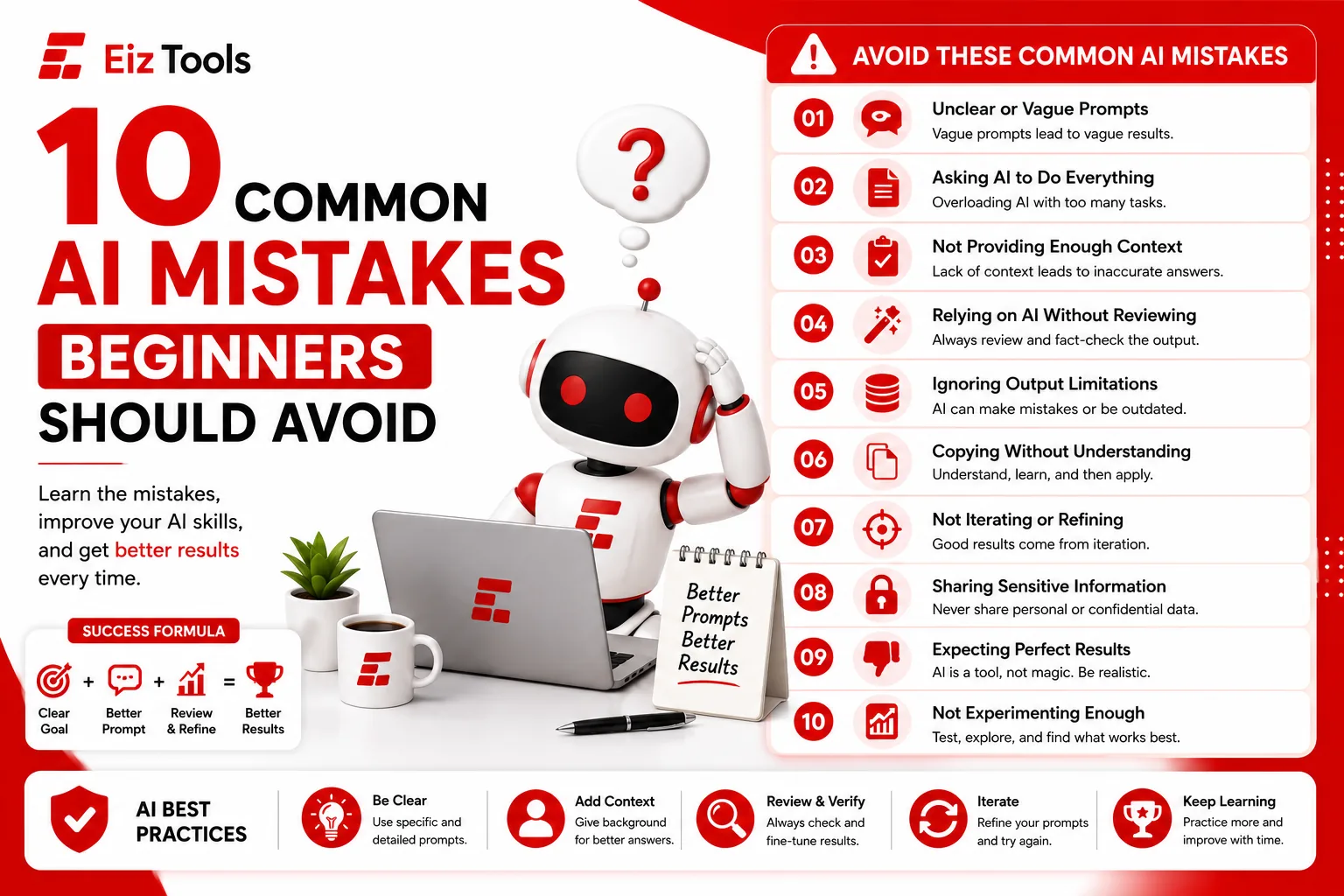
The single biggest difference between people who get remarkable results from AI and those who feel frustrated with it is almost always the prompt. Not the model, not the subscription tier — the prompt. The AI Prompt Optimizer exists to remove that gap for everyone, not just the technically skilled.
EizTools Creator
Frequently Asked Questions
Does the AI Prompt Optimizer work for image generation prompts, not just text?
Yes. The Target AI Model dropdown includes Midjourney as a specific option. When you select it, the AI Prompt Optimizer adjusts its approach to match the grammar and style conventions of image generation prompts — emphasizing descriptive adjectives, visual style references, aspect ratio instructions, and compositional cues that matter in Midjourney but would look out of place in a ChatGPT prompt.
How is Token Efficiency different from just choosing a shorter Output Length?
They're related but distinct. Output Length controls how long the finished prompt is relative to your original. Token Efficiency as an Optimization Goal specifically prioritizes removing redundant phrasing, filler words, and verbose constructions that consume tokens without adding meaning. You can combine them — Token Efficiency goal with a Shorter output length — for maximum compression when context windows are tight.
Can I use the AI Prompt Optimizer to improve prompts I didn't originally write?
Absolutely. Many users paste in prompts they found online, prompts shared by colleagues, or prompts from AI prompt libraries that are close to what they need but not quite right. The AI Prompt Optimizer treats any text input the same way — your authorship of the original prompt doesn't matter for how it processes the optimization.
What does Add Role Context actually do to my prompt?
When you choose Add Role Context as your Optimization Approach, the AI Prompt Optimizer prepends a persona definition to your prompt — something like "You are an experienced senior data analyst with expertise in financial modeling…". This helps the AI model adopt a specific knowledge frame and communication style before responding, which tends to produce more authoritative, focused, and domain-appropriate answers.
Is there a limit to how many prompts I can optimize per session?
The AI Prompt Optimizer is free to use on EizTools with no subscription required. Usage policies may apply as with all tools on the platform, but there is no hard cap that would prevent you from optimizing multiple prompts in a single session or returning to optimize more prompts the next day.
Can the AI Prompt Optimizer help if I am not writing in English?
Yes. The Output Language setting lets you receive your optimized prompt in Spanish, French, German, Italian, or Portuguese. If you're running AI sessions in one of those languages, you can write your rough idea in that language or in English and receive the polished, ready-to-use prompt in your preferred language. The optimization logic — clarity, conciseness, role context — applies equally regardless of the output language.
Start Crafting Prompts That Actually Deliver — and Stay in the Loop
Thank you for spending time exploring the AI Prompt Optimizer with us. Every great AI interaction starts with a well-written prompt, and now you have a free, capable tool to build those prompts without having to become a prompt engineering expert yourself. Whether you're unlocking better creative writing from Claude, sharper data analysis from ChatGPT, or more vivid imagery from Midjourney, better prompts are the fastest path to better results — and the AI Prompt Optimizer puts that upgrade within reach instantly. You can also explore the full range of AI Prompt Tools on EizTools to find complementary tools that fit your workflow.
We'd love for you to stay connected. Visit EizTools and follow us on social media for the latest tool launches, prompt tips, and AI workflow ideas the moment they go live. Turn on push notifications so you never miss a new feature, and subscribe to our newsletter for curated AI updates delivered straight to your inbox. The world of AI moves fast — let us keep you ahead of it.

Sabir Bepari
Founder of EizTools and a passionate AI enthusiast dedicated to building practical, user-friendly AI tools that simplify everyday tasks.
Follow EizTools
New AI tools, practical tips and product updates — straight to your feed.